Monday, October 24, 2011

Good News for the Rouge: Removal of Concrete Channel being Considered

Your feedback is needed!

The Detroit District of the Army Corps of Engineers is currently considering undergoing a restoration of the channelized section of the Rouge River, and the public will have an opportunity to submit comments before November 7th. The removal of the concrete and replacement with a "soft-engineered" shoreline could lead to more riparian and aquatic habitat in that area of the river, may provide opportunities to increase the public's use of the river (imagine kayaking and, rowing off of Michigan Avenue), and would just plain look nicer than concrete!

You can find out more about good practices for governments and the connection between infrastructure, watersheds, and rivers here: http://nemo.udel.edu/manual/Chap2Web.pdf

If you are interested in submitting a comment to the Army Corps of Engineers regarding the restoration of the concrete channel, please see below for more details.

Excerpt:
The Corps of Engineers (COE), Detroit District, has completed the "Detailed Project Report and Environmental Assessment" report for the first phase of restoration of the Rouge concrete channel from Michigan Avenue downstream about 1.4 miles to the vicnity of Rotunda Drive. The COE is in the process of gathering public comments on the proposed Rouge River restoration project. I have attached the public notice. The full report including appendices is available from the COE website at:

http://www.lre.usace.army.mil/projectsandstudies/planningstudies/upper_rouge_river_section_1135/index.cfm?


You can also contact Ashley Binion of the COE at 313-226-2657 if you would like a CD of the document mailed to you.

Any comments on the report are due no later than November 7.

This project will restore the riparian and aquatic habitat within a large part of the concrete channel section of the Rouge River, will provide opportunities to increase public use of the river in that area, and is key to our vision for restoring all beneficial uses of the Rouge River. I hope you will join Wayne County in supporting this project. Please send any comments you may have to the address listed in the public notice letter.
Regards, Kelly

Kelly A. Cave, P.E.

Director, Water Quality Management Division
Wayne County Department of Public Services
400 Monroe, Suite 400
Detroit, MI 48226

We hope you consider submitting a letter of support for this restoration project!

Link to the Public Notice Letter: http://scr.bi/t87OXL

Tuesday, October 11, 2011

Great Lakes [policy]! H2O Now! The International Joint Commission Biennial Meeting


Friends,

The International Joint Commission (IJC) has a meeting for everyone in the Great Lakes region-U.S., Canadian, First Nations--every two years in October. They coordinate with the EPA, Environment Canada, countries, various watershed groups, businesses, academics, and take comments from the public to inform better water policies. It also hosts free workshops for all who wish to attend and is open to comments from the public.

That meeting is happening now! (Oct. 11-14, Tuesday-Friday) You can register here http://meeting.ijc.org/, registration is free! Be aware that parking is $5 though!

Your voice and insight is important! This year the meeting takes place in Detroit at Wayne State University and (again) is free to attend. Please spread the word and attend if you're available to do so.

David Dempsey, a Policy Advisor with the IJC, spoke at the UM-Dearborn Social Science building urged the audience likewise today reiterating the importance of education and vigilant community engagement at events like the IJC Biennial Meeting--"possibly one of the few times the public can deliver remarks in person to major decision makers of the Great Lakes." Having attended the 2009 IJC meeting, I was surprised to find myself as one of the only people in the 30 years and under age bracket attending the comment session.

Dempsey also urged audience members that even though Asian Carp and the condition of Lake Erie will likely be well vocalized issues, don't forget to represent what's going on near you too!

Not ready to submit comments but want to learn?

In addition to public comment sessions, there will be workshops and educational sessions to bring the community up to date on timely developments in science, policy, and perhaps even the economics surrounding the Great Lakes, other inland water bodies and the communities they're integral to.

For those who are looking for things to ponder prior to attending a session, here are some questions for you to consider: Is surface and ground water where you live drinkable, swimmable, fishable (a goal in the EPA Clean Water act on behalf of the citizens who sought a healthy place to live)? Do legal questions about commerce and water access keep you up at night? Does your community's storm water system and sewer drains still discharge into local rivers and tributaries? What are things that citizens can do to make a difference in their community to help improve the condition of the Great Lakes? This is a great time to find out.

We hope to see you there! The SEA is arranging for a few carpools, but to our friends at Wayne State University and those among the greater Detroit community, please be sure to check it out!

Friday, September 30, 2011

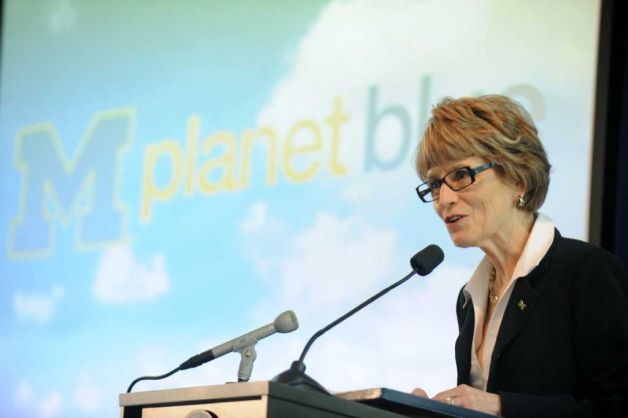
UM President Mary Sue Coleman declares University Commitment to Sustainability

"We will be aggressive and relentless.
As a campus, a community, and a planet,
there is no other approach to take.

I want the message to be clear:
Sustainability defines the
University of Michigan."

- Mary Sue Coleman,
University of Michigan President

Source: http://sustainability.umich.edu/news/going-green-staying-blue-sustainability-michigan

A few observations about her speech:

1) Coleman seems to view sustainability as something specific to environmental programs only. This view ought to be updated--clearly social justice and economic issues are integral to our relationship with the world we live on. Reading "The Death of Environmentalism" might be a good way to start out: http://thebreakthrough.org/PDF/Death_of_Environmentalism.pdf

Comprehensive sustainability in Institutions of Higher Education like the University of Michigan can provide a coherent focus for educational programs to address real world problems on the local and global level, while encouraging people to understand the interconnections between the scales. Advancing sustainability with exclusive focus on environment denies the opportunity for better insight to complex issues--how does one implement solutions justly to all communities concerned (social)? What is the most prudent course of action (economics) for doing so?

2) For those wondering, her hesitation to sign the President's Climate Change Commitment in the past seems to arise solely from legal concerns:

"After seeking expert counsel, we have concluded we cannot set a date by which we will achieve carbon neutrality. There is simply no viable way forward at this time to achieve such a feat, and I will not place an undue burden on the backs of future presidents of this great institution."

It's interesting to see that some of the legal pushback regarding accelerated anthropocentric climate change was carefully considered here. Perhaps I'll have more substantial comment about this later, but I wonder what recent climate change litigation (perhaps the communities bringing suit to major petrol industries?) prompted this statement.

3) A friend said: "Wow! So what does that mean for Dearborn? She talked a lot about Ann Arbor." Maybe she forgot about Dearborn and Flint; more likely, however, I suspect she doesn't have a good feel for what's going on in the way of sustainability at these other campuses.

Either that or she relied almost exclusively on the results from the report for the Ann Arbor campus "integrated assessment" for her speech.

In any case, this is a good opportunity for all of our campuses to take the lead and demonstrate what comprehensive sustainability at a University ought to be about. It would be nice if the three major campuses got together for a meeting of the minds between interested students, faculty, and staff finally.

Juliana Goodlaw-Morris of the National Wildlife Federation offered her support to help coordinate or moderate between the three campuses so we can flesh out a comprehensive framework for sustainability as The University of Michigan, but also so as to inform our particular needs at our specific geographical locations (Ann Arbor, Dearborn, Flint).

We've invited several key individuals from U of M Ann Arbor and U of M Flint to join us at Campus Sustainability Festival and hope that they'll join us there. We'll be as politely relentless and aggressive about getting something coherent going (as aggressive and relentless as civil students can be at least). We just need some reciprocal lovin' to come from them in the form of a "yes, let's do something together".

As an aside, I've got mixed feelings about that "aggressive and relentless" statement from President Coleman--it sounds more like an angry battle cry than anything else. In any case, it certainly was fun to use in this post!


Edit [Nov. 5 2011]:  I just found a separate article outlining additional goals for "The University", which brings forth additional questions and suggestions:

How do they define "The University"?

  • Protect the Huron River through best-in-class storm water control strategies and by applying 40 percent fewer chemicals to campus landscapes, and ensure that at least 30 percent of stormwater runoff does not flow into the Huron River.
Why wasn't the Rouge River watershed considered for better storm water control strategies?  The native garden/bioswale project is an excellent fit for meeting or surpassing the goal of a 40% reduction in chemical applications and 30% stormwater runoff reduction.

  • Promote sustainable foods while supporting more Michigan farmers and producers. From the residence halls to the unions and hospitals, the university is introducing new purchasing guidelines and making a commitment that at least 20 percent of U-M food comes from local and sustainable sources.
How does this affect our campus?  Do these policies apply to all UM campuses?  Where can we access these purchasing guidelines?  When does this take effect, and how does our contract with Aramark get adjusted?

Monday, September 12, 2011

September SEA Events

September is going to be a busy month for the SEA! See the "Resources" page on SEA's blog for a map of the campus. Come when you can, go when you must.

Tues. 13th 12:00-3:00pm: Student Organization Fair

Thurs. 15th 4:30-6:30pm:
SEA Meeting/potluck meet and greet

Fri. 16th 11:30am-1:00pm:
Sustainability Fest planning meeting and pot luck with EverGreenTeam

Sun. Sept. 18th 9:00am to 2:00pm:
SEA Working Day

Thurs. Sept. 22nd:
10:00 am:
City of Dearborn’s Adopt-A-Watt program launch at (RSVP required by Sep. 19)
4:30-6:00PM: SEA Meeting and Officer Elections

Welcome to the new semester! The autumn winds bring a rush of events for The Student Environmental Association here at UM-Dearborn, and you're invited to join us!

Tues. 13th 12:00-3:00pm Student Organization Fair--Can you help us greet incoming students and spread the word about SEA at our table behind the University Center? Please let us know, 15 minutes of your time can make a big difference in recruiting and finding out what's happening on campus!

Thurs. Sept. 15th 4:30-6:00pm Our semester kick-off meeting takes place -- let's make this one a meet-and-greet potluck for sustainability. We'll pick up on the summer's events and talk about the new semester, too.


Fri. 16th 11:30am-1:00pm: Sustainability Fest planning meeting with EverGreenTeam room 1070 Administrative Building (at UM-Dearborn's campus)


Theme for this year: Fresh Water. Join us as we plan and coordinate the events with various campus and community allies for this year's week long October festival on sustainability! (We'll make a better image for this year's festival theme)...

Sun. Sept. 18th 9:00AM to 2:00pm* SEA working day at the Environmental Interpretive Center! Help us out with various projects, make/distribute fliers, learn about native/invasive species, meet and greet friends new and old! We're hoping to finish up around 2:00 or 3:00 pm, but this depends on who will be available, what gets finished, and whether we decide to eat on campus or off.

Thurs. Sept. 22nd: TWO MONUMENTAL EVENTS IN ONE DAY!!
(two exclamation points to denote two significant things!!)

City of Dearborn Adopt-A-Watt program launch at 10:00 am on the West Parking Structure on West Village Drive in Dearborn’s west downtown

Launch of the City of Dearborn’s Adopt-A-Watt program at 10 a.m. on Thursday, Sept. 22, 2011. This public ribbon-cutting ceremony will recognize Adopt-A-Watt charter sponsors for their efforts to save energy and reduce City expenses through their adoption of new energy-efficient lights in one of our parking structures. The SEA helped the Dearborn Sustainability Coalition promote this program this summer at the Dearborn CARES Festival. Attached is a press release issued earlier this month by the Adopt-A-Watt organization.

Media will be invited, as will suppliers of energy efficient products and the Adopt-A-Watt founder, Thomas A. Wither.

Additional details about the program and organization are available at: http://adopt-a-watt.com/

Kindly confirm your attendance before September 19 by email (bcampbell@ci.dearborn.mi.us) or by calling the City of Dearborn Department of Public Information at 313-943-2285. Parking is free. Please show your invitation at the entrance.

SEA Meeting and Officer Elections at 4:30-6:00PM
The SEA has a meeting once again, elections for officership take place at this time, but you can also vote online (more on that this Thursday). We're looking for individuals interested in any of the officer positions. If you are interested in running for a position please let us know either via facebook or by e-mailing us confidentially at greenwolverines (at) ymail (dot) com .

We have many exciting projects and opportunities in the works for this term and we need some people to step up to the plate for leadership opportunities. If you have any questions please reach us!

Saturday Sept. 24th We will be selling our native plant seeds at the Master Gardeners Association of Wayne County conference here at UM-Dearborn and meeting many of the regions greatest greenthumbs.

As always, we welcome your interest and inquiries--feel free to reach us via facebook or e-mail!

Cheers to a fine new semester!

The Student Environmental Association at The University of Michigan-Dearborn

Saturday, August 27, 2011

Closing notes from the EPA EJ Conference

More details later [this post will be expanded], brief recap from the EPA Environmental Justice conference's recap as of 27 August 2011:

The EPA conference has adjourned with discussion about the efficacy/inefficacy of human and civil rights legal entities--US, how its applicability is unclear for tribal nations, and recommendations to pursue international human rights jurisdiction as an alternative route since current US environmental health protections are insufficient.

The EPA is currently backlogged with 40 complaints

Title VI (on human/civil rights) has been deemed an outstanding potential resource, but is currently ineffective due to lack of enforcement/ enforcement capacity and conflicting systems between the US EPA and US Department of Justice.

Title VII (on civil rights to employment*) has also been deemed a potentially powerful tool--when afflicted communities contribute to becoming the leadership of major companies and organizations, it follows that closer consideration for human rights and sensitivity to environmental quality will be given (stated by Rhode Island environmental lawyer Stephen Fishbach).

Proof of direct causation for harm is a common legal misconception for those suffering health issues from environmental problems (response from the US Gulf of Mexico Enbridge/BP spill fund continue to use direct causation as a way to deny current claims.

Recap on the conference, and next step/future recommendations were also shared--neat idea from Brazillian delegate: Inform consumers about the products they use with an Environmental Justice label.

Potential locations for the next EPA EJ conference? Coal belt Appalachia, First Nations Territory(/ies), First Nation Territory in coal belt Appalachia, North Carolina. Satellite/web/television broadcasting
As an aside, pictures from Thursday's Science Cafe are coming soon too, thank you to everyone who supported the event in their presence or their works unseen!

*I'll have to look at my notes again from the rush transcript of the panel session for more details when I have freer time.

Wednesday, August 24, 2011

An EPA afternoon: participatory community learning and education


First, there's still time to participate in the EPA's Environmental Justice Conference here in Detroit--it's free, they take walk-ins, and your participation is meaningful!  Go here to see where it's at and what's going on tomorrow:  http://www.cleanairinfo.com/ejconference/agenda.htm

This is a mix of summary and commentary on today's events from the afternoon EPA Federal work group session.  I participated in the community organization working group, and later attended the panel for "The Detroit Story".


Interesting news came out of the ongoing EPA Environmental Conference today. This afternoon we realized that people all over the U.S. are striving to organize, but there's a lot of organizational fragmentation.


[More after the page break]

Tuesday, August 23, 2011

Plants to know and a cup of joe...our second science cafe!

Cardinal flower (Lobelia cardinalis)
is a native Michigan plant.

Its roots can grow to 8 feet!
Image compilation by Ian Tran,
coffee cup credit to Flickr user BallistikCoffeeBoy
Join us for a cup of bird-friendly coffee and discussion about the role of native plants in our communities!  


Ethical and legal concerns about landscaping? 


Find out from an individual who navigated them and made it happen in Dearborn Heights!

Curious about what plants can make a great habitat for many to enjoy? 


Let's further the dialog!


Thursday, August 25th 
6:00 pm
in room 116
UM-Dearborn Environmental Interpretive Center 
4901 Evergreen Road Dearborn, MI 48128

You're invited to join us for this informal discussion on native plants, landscaping, and our connection to it all to make a more vibrant ecosystemic and human community in the Southeast Michigan area via the landscapes we live with.

This science cafe features special guests, among them Steve Ray of the Dearborn Heights Watershed Commission, 
Martha Gruelle of the Stewardship Network, and of course: YOU!  Dearborn's Sustainability Coordinator and esteemed alum of UM-Dearborn David Norwood will also be joining us.

Also, we're hoping to serve Bird Friendly Coffee again, and will have fresh UM-Dearborn made honey.

Please RSVP to the Student Environmental Association at The University of Michigan-Dearborn here on our facebook event or at greenwolverines (at) ymail (dot) com so we can better plan the event.

Wednesday, August 17, 2011

“UM-Dearborn Natural Area Appreciation” Questionnaire

Greetings, Friends and Lovers of the University of Michigan - Dearborn Natural Area!

My name is Sara Cole, long-time student staff member at the Environmental Interpretive Center, and I am reaching out to you on behalf of fellow students and staff who regularly use the Natural Area for educational programs and wish it to stay accessible as a place of learning far into the future. In order to do that, we need to hear from you. Our goal is to compile a great collection of feedback which attests to the UMD Natural Area's educational value to those who have participated in a program/class there. If the Rose Garden Pond and Natural Area mean something to you, we want to hear about it! 

It would be absolutely wonderful to get responses from the following people: 
  1. Students (and Alums) of Field Bio, etc.
  2. SEA Members
  3. Staff at the Environmental Interpretive Center  
    (current and past)
  4. K-12 students & the General Public
The deadline for responses is September 12 [edit: the deadline is tentatively extended to October 1st]. 
I'll send everyone reminder email next week, and an update in September.
Bonus: Select responses may be featured on the EIC website. . 

I look forward to hearing what the UMD Rose Garden Pond and Natural Area mean to all of you

Thank you,

Sara Cole 
sscole(at)gmail.com
EIC Staff/Student Naturalist (2008-present)
RRBO Volunteer Bird Bander (Fall 2010)
“What one does is what counts. Not what one had the intention of doing.”- Pablo Picasso
"Do or do not. There is no try." - Yoda


If you'd like to download the survey, here's the link: http://scr.bi/UMDbrnNatAreaSrvy


###Survey begins here (click on the jump break)###

Friday, July 22, 2011

Detroit Frack Ban Resolution status: unanimously passed!

The resolution didn't get on Tuesday's agenda, but it has been well represented and
voted on today (Friday the 22nd) during the noon session.

I called Chris Corrigan of the Detroit Food and Water Watch office at about 1:30 today and learned that the Detroit City Council passed the ban by unanimous vote.  This is literally a watershed event.  Most of the communities upstream in the Rouge River watershed (Westward from Dearborn out to Superior/Salem Townships, and North out to Rochester Hills, Bloomfield/West Bloomfield Townships, and Novi) get their municipal tap (drinking) water from the Detroit river--which the Rouge drains into.

As far as I could reckon, Food and Water Watch, Dearborn/Dearborn Heights League of Women Voters, the SEA, and Akinpelu twins were in attendance on Tuesday.  Details forthcoming as we find out what happens next. Those who spoke got their concerns for safety and its regional relevance to Southeast Michigan across--it piqued councilman Brown's interest and he expressed his thanks to all of the youth who came to represent their solidarity in the issue.  

Congratulations for your leadership Detroit, it's a major step forward in citizen and environmental protections.  Also, please be vigilant in following through--you can propose similar resolutions in your hometown too!

That said, I believe the city of Detroit and groups like Food and Water watch will also need to look in earnest toward something creative and solutions oriented for responsibly meeting energy and employment needs.  They've got very bright talents in the area, and it's time to make it known that Detroit's leadership is happening from all directions at all levels of Southeast Michigan.

Wednesday, July 6, 2011

Meeting July 11th, other news

We'll be meeting 
Monday July 11th 6:00pm 
on the second floor of the University Center in the SAOC
to plan for Fall Semester, take care of various projects, lay out some of our collaborative event plans, etc.

We're updating our mailing list too. To better plan how and what we communicate with you, please let us know:
1) if you'd like to be removed from the list
2) do you find the occasional job notices, conferences, internships, and volunteer opportunities valuable?
3) is there anything you'd like to lead or see happen in the future?
You can reach us at greenwolverines (at) ymail.com


Interesting news tidbits:

  • Ready or not, your city may be very capable of adapting to accelerated climate change--Detroit's ranked in the top 3 (Cleveland got 1st place)! 
  • Check out the 1000 scientists in 1000 schools initiative. This would be a good complement to the NOVA ScienceNOW and Future City programs. http://bit.ly/mRKsjw
  • Bright ideas by youths of Detroit (and some from Dearborn) gave ideas and some plans at the ESD Future Detroit symposium, the report has been published and one of SEA's members got to facilitate and author with workgroup 4.   Issues of environmental justice and asthma didn't fit the final publication, but you can read the full unedited write up by requesting for a copy from the ESD (http://esd.org).
  • The Pentagon has announced its energy/environmental strategy, hear parts of it discussed on the Diane Rehm Show: http://bit.ly/p269Qw  There'll be a time when the necessity of peaceable education overcomes the present reality of global conflicts soon, but all things considered it's still relatively good news as these perspectives in energy use are being put into action and will likely trickle into other parts of administrative and public attitudes toward sustainability.

For the 4th of July several of us went out to Ann Arbor to help with the last hoop house build for the 20 hoop houses in 20 days project--only to find a neighborhood without people building hoop houses (we probably rsvp'd too late and missed out on important details).  We saw a guy with a cello standing on the sidewalk without a shirt, a rockin' community garden in the Waterhill neighborhood, and then all three of us carpooled to visit the Michigan sailing club to partake in their potluck instead discussing bits of democracy and good books on a fine sunny day.  Hope you had a great and enriching 4th of July too!

Wednesday, April 13, 2011

What the Frack!?! Fracking Party: Gasland Screening Wed. April 20th 6:00pm-9:00

What  the  [is] frack!?!

Wed. April 20th 6:00pm-9:00 the SEA will be screening Gasland in the Environmental Interpretive Center at the University of Michigan-Dearborn:


Gasland is a documentary concerning Hydraulic fracturing (fracking)--a means of natural gas extraction within deep natural gas well drilling.  Once a well is drilled, millions of gallons of potable (drinking) water, along with sand and proprietary chemicals are injected under high pressure into a well. The pressure fractures shale rock and props open fissures that enable natural gas to flow more freely out of the well.


Awareness of this process and issue is especially relevant to us because Michigan and the Great Lakes basin are prime locations for natural gas extraction, and several communities have reported affliction  (see USGS/EIA maps below for existing natural gas locations).

 Furthermore, it's ongoing at present within our state. 


Gasland has been subject to several criticisms.  See some from:

1.  Energy In Depth--a blog assembled by a collection of U.S. Natural Gas and Oil producers 
2.  Blogger Kirian Stacey of the Financial Times
3.  Ongoing discussion by insightful folks at the Oil Drum (see comments near the end for people who actually worked in the industry and/or watched the film)--some of whom claim that the criticisms from Energy In Depth can be rebuked

We'll try to make sense of them and weigh out its merits with some geology, environmental science, sensibility, and civility.


Join us to examine the topic at hand, as well as the documentary itself--how are the issues communicated?  What does it mean to all of us as citizens and consumers of media and energy?  Also important to consider: what alternatives can we pursue to minimize our dependence on fossil fuel extraction and consumption altogether?


Trailer:


Please join us at this fracking party, popcorn and beverages will be served at the event, so it's a fine opportunity to stop by and take a break from your studies!!  Please RSVP to greenwolverines (at) ymail (dot) com

Friday, April 8, 2011

Science Café #1: The Coffee Connection to Birds and Biodiversity

Photos and notes from our first Science Café: "The Coffee Connection to Birds and Biodiversity":


Thanks to everyone who came out -- special thanks to everyone who helped set up/tear down, featured guest speaker Sara Yearout for sharing her senior research project and passion for sustainably sourced foods, Julie Craves (head of Avian Research at Rouge River Bird Observatory and shade-grown coffee authority) for sharing her expertise, Sara Cole for sharing the photos, Birds and Beans for their wonderful "Chestnut-Sided Warbler" blend of coffee, and the SEA members who helped make this event happen! Though the books didn't arrive in time for the event, great things happened nonetheless.


In case you missed it, here are some "tasty tidbits" from the discussion:

  • "triple crown" (fair trade, organic, bird-friendly) coffee is the golden standard at this time.
  • Look out for the fine print on certified coffee! Some certifications, like those awarded by the Rainforest Alliance, may actually certify only a certain percentage of the coffee to be shade-grown (30% for example) in the fine print.
  • Some growers and suppliers cannot afford to get certified, but may still label their coffees as "bird-friendly".
  • Caribou Coffee is working to get all of their coffee Rainforest Alliance Certified by 2012, while Starbucks has internal standards for suppliers that tend more toward fair treatment of the farmers, but may not necessarily be bird-friendly at this time
  • For some insight on how coffee (and chocolate) tie in with climate change, this rainforest alliance webpage is a fair source: http://my.rainforest-alliance.org/site/MessageViewer?em_id=6361.0&dlv_id=10981
  • Even if you're not a coffee drinker, are there places where you can educate coffee consumers about their connection to coffee, or help them make more sustainable purchases? Local cafes, the workplace or at home might be good places to start.
  • Since coffee is exported into Michigan, it's worth recognizing that it does have a substantial ecological footprint.
Birds and Beans: http://www.birdsandbeans.com/
Sara's Co-Op, Ypsilanti Food Coop: http://www.ypsifoodcoop.org/
Equal Exchange Coop (Chocolates and other things): http://www.equalexchange.coop/

A pleasant coincidence I forgot to mention: the event was hosted at the Environmental Interpretive Center, a building was designed to look like a bird in flight from above!

Here's to drinking sustainably -- cheers!

Thursday, March 31, 2011

The Coffee Connection to Birds and Biodiversity (A Science Cafe!)

Wed. Apr. 6th 5:30-7:00 room 119 of the Environmental Interpretive Center
The Coffee Connection to Birds and Biodiversity science cafe

Even if you're not a coffee drinker, find out how you can:
-Preserve rain forests, birds, and other fauna
-Make a difference in climate change
-Create new economic opportunities for coffee plantation owners and farmers
-Help others drink better quality coffee
Plus, free samples of bird-friendly coffee and a raffle for a hardcover autographed copy of Bridget Stutchbury’s ‘Silence of the Songbirds’ all courtesy of Birds and Beans (Thanks!).
Join us for this informal discussion featuring UM-Dearborn Environmental Studies senior, Sara Yearout!

Please rsvp to greenwolverines (at) ymail (dot) com or on our facebook event page so we can better plan the event.

Thursday, November 11, 2010

Footage and Photos from 10/10

The Cool Cities Dearborn Sierra Club brought together several groups to host events on 10/10 as initiated under 350.org.

Dearborn's Community Television Channel also got footage of some of our activities and interviewed us:

I'm finally uploading pictures from 10/10!  It was a great event with upwards of ~45 people joining us to enjoy the outdoors for the Global Work Party Climate Action Day to walk, learn about the area, put bottled water to the test against tap (LWVDDH report no significant difference in preferences, but tap is 1,000 times cheaper!), paint pumpkins and gourds, and meet other community members.

Jenni Dunn of the Dearborn/Dearborn heights League of Women Voters at the blind tap vs. bottled water taste test table. Find out more about their actions and findings at their blog post on the 10/10 tap water taste test! 
Attendees gather for opening remarks on environmentally conscientious recreation, sustainability, and climate action from Ian Tran and Shannon Morrow before touring the Environmental Interpretive Center rain gardens, natural areas, and Rouge River Henry Ford Estate.
Pumpkin!  Apple from Apple Charlie's!  Cider and donuts also came from Apple Charlies, and we had attendees use compostable cups as planters for wild mountain mint (Pycnathemum pilosum) seeds collected by SEA--it was a leave-no trace event so all other items were composted or taken back for recycling/reuse.  The Fordson High School Environmental Club came forth in strong numbers and hosted the pumpkin painting table.

350.org participants gathered in all kinds of shapes, we made an Evergreen 1Sky, and the Sierra Club have signs up.
Several local parents hiked with their children, literally!


Sunday, October 31, 2010

Non-partisan voter guides for the general elections

Friends and fellow citizens,

Tuesday is general election day, please remember to vote as participation is a fundament of our democracy.

Equally important is to cast a well-informed vote as the outcomes of these elections impact generations to come.

Environment is a key part to many candidate platforms, and the following non-partisan guides may help you to better discern what their current positions are.

League of Women Voters:
Part I
http://www.lwvmi.org/documents/LWV2010p17-32REV_001.pdf
Part II
http://www.lwvmi.org/documents/LWV2010p1-16.pdf

League of Conservation Voters:
Brief guide:
http://michiganlcv.org/sites/default/files/Snyder%20&%20Bernero%20Brief%20Chart.pdf
Detailed guide:
http://michiganlcv.org/sites/default/files/MLCV-Full-Gubernatorial-Comparison-Chart-final-jk.pdf

Please also note that the gubernatorial candidates have differing stances on new coal plants, fossil fuel (especially natural gas) exploration, and nuclear energy in Michigan.  As many of us have learned through our studies or from experience, these factors do have a legacy of negative environmental, social, and economic consequences which merit careful consideration.

Have a safe and Happy Halloween!

Saturday, October 9, 2010

Global+Local=GLOCAL! 10/10 Global Work Party happening in Dearborn!

The Dearborn Sierra Club Cool Cities Group, Dearborn/Dearborn Heights League of Women Voters, Student Environmental Association (SEA), and Fordson High School Environmental Club are getting ready for 350.org's  international "Global Work Party" day this Sunday 10/10 2:00-4:00 at the University of Michigan-Dearborn Environmental Interpretive Center (4901 Evergreen Road, Dearborn MI 48128) and you're invited to join us for the event!


You can join us for a low-carbon walk through the Henry Ford Estate Grounds/Natural Area to the community organic gardens, cider and donuts from Apple Charlie's, a discussion on environmentalism, trade tips with other cool citizens on energy conservation, sustainable food options, gourd painting (perfect for Halloween preparations!), you even can plant some wild mountain mint collected by the SEA to take home.

What's even more exciting is that over 7,000 events like this are going to happen world wide on the same day (but none are quite the same as our adventure in the making!).  Perhaps "glocal" would be a good way to describe this kind of event.  It's a coordinated local activity with global impacts--a conjugation of the phrase "think global, act local"... Global+Local=Glocal.

All of these events revolve around themes of community building, climate change action, and enjoying what you're doing in the process.  You can find out more and RSVP at 350.org .  Of course, you can just stop by and join us too.

People of all ages are welcome, unfortunately pets are not because the walk goes through a research area at the University.

Tuesday, September 14, 2010

The Vegan Sub Sandwich Option

Do you like healthier, affordable, environmentally and ethically responsible food options?

If yes, then we're pleased to inform you that Dr. Skrbina's vegan sub sandwich proposal to the campus Subway as a viable way to make it happen sooner.  These arguments are applicable to campuses everywhere, but you may have to check the prices.  Our campus subway charges a bit more across the board than most other subways do.  Here's a bit from Dr. Skrbina:

At present there is only one way to buy a vegan sub: the Veggie Delight (all fresh vegetables), with vinegar and oil dressing. This sells for $5.29, the same price as if the customer included cheese, egg-product, and dairy
dressing. By comparison, the ham sub is $5.89—just $0.60 more. Subway’s (and Aramark’s) profit margin on such a ‘vegan sub’ is undoubtedly huge—surpassing every other product they sell, given that the ingredients are the lowest-cost. And given that a ‘$5 footlong’ is a viable product, and 3 for $12, we should expect a sub-$5
price on the vegan alternative.

In effect, buyers of a vegan sub are subsidizing the non-vegan and meat subs. Based on the above facts, it should be the other way around: vegan subs should be the cheapest, and the cost burden placed on the meat.
 Full paper below:

Friday, September 3, 2010

Liveability, walkability, and public hearings that could make it happen sooner!


Have you ever thought "Gee, crossing Evergreen Road and Hubbard as a pedestrian can be mighty dangerous!  I wish I could safely walk
from the Main Campus to the Fairlane Centers..."
after class ended and the shuttles stopped running?


The following public meetings are opportunities to make the University of Michigan-Dearborn campus more walkable (maybe even less liable!), and the city more livable (which also helps reduce regional vehicular emissions) are coming soon.  Also, ask Dr. Bazzi if the public hearings merit ESCI/ENST 385 seminar credit.