Showing posts with label Environment. Show all posts

Tuesday, May 21, 2013

Keystone going to vote in the House


Keystone XL likely up for vote tomorrow [1]. The health, social justice, and environmental side of the issue (though likely among the most important topics) probably won't get as far without a coherent alternative on the economic "job creation" side for those of the GOP [2]. Perhaps speaking about the risks to local economies can make a measured difference?

Recall that the communities in Kalamazoo/Marshall [3-5] and in the Gulf are still struggling (and some angry) to recover from spills in 2010 [6, 7].

What will we do?


[1] http://thinkprogress.org/climate/2013/05/21/2007191/may-21-news-gop-plans-keystone-approval-vote-tomorrow-house-dems-clarify-true-impact/

[2] An extrapolation based on Frank Luntz's insight.  Luntz remains a leading adviser for "messaging" strategy, in Washington, esp. to the GOP.  Phrases like "climate change" (promoted to reduce sense of alarm created by "global warming"), and "death tax" are a product of his advisory.
http://www.motherjones.com/mojo/2010/01/gop-pollster-luntz-tells-enviros-stop-talking-climate

[3]
http://environmentreport.org/enbridge_oil_spill.php

[4] Enbridge resisting final clean-up of spill as of January 2013 http://insideclimatenews.org/news/20130128/dilbit-6B-pipeline-kalamazoo-river-enbridge-oil-spill-michigan-keystone-xl-epa

[5]   ~Kalamazoo is nation's most costly oil spill
http://www.bloomberg.com/slideshow/2012-07-25/enbridge-s-quiet-765-million-oil-spill.html

[6] Check out the current news in Florida!
http://www.naplesnews.com/news/gulf-coast-oil-spill/

[7]  http://www.theatlantic.com/national/archive/2013/04/three-years-after-the-bp-spill-tar-balls-and-oil-sheen-blight-gulf-coast/275139/

Thursday, February 28, 2013

Contentions with SB78 and policy recommendations

Waterloo Recreation Area in Pinkney, MI 2010
Photograph by Ian Tran
[The views presented here do not necessarily reflect those of the Student Environmental Association at The University of Michigan-Dearborn]

Honorable Governor Snyder and Honorable Senators of the Michigan State House:

I provided ecological economic advisory for the City of Dearborn’s sustainability master plan and was nominated subsequently for the Dearborn Mayor’s Environmental Commission in 2010.  I remain an ardent proponent for examining issues by their existing and potential consequences they have on people affected by the intermingling of social, economic, and environmental challenges.  I’m a realist rather than an environmentalist.  I oppose and urge you to oppose SB78, which strives to amend the Michigan Natural resources and environmental protection act, for the following reasons.

Summary of contentions:
1) SB78 would create uncertain and ambiguous risks to the state, businesses, and citizen taxpayers
2) Economic and scientific research provide compelling if not clear reason for environmental conservation
3) Underutilized or unconsidered alternative consensus processes exist for sound risk governance, programming, and policy solutions to ensure benefit for all stakeholders

1)  Removing regulatory capacity for conservation from state agencies create ambiguous risks which can negatively impact the state, local businesses, and citizen taxpayers in the long-run

The International Risk Governance Council (IRGC) categorizes uncertain and ambiguous risk [0] as follows:
■ Uncertainty refers to a lack of clarity or quality of the scientific or technical
data.
■ Ambiguity results from divergent or contested perspectives on the justification,
severity or wider meanings associated with a given threat.
SB78 facilitates uncertain risk because we lack proper baseline data for accurately recognizing state-level benefits of biodiversity and conservation management, yet the legislation seeks to reduce the state’s ability to maintain and manage the areas crucial for data collection and analysis.  We also have few guarantees that unforeseen consequences of resource extraction (i.e. natural gas, shale oil) will have proper and thorough remedial response.  Many of those who testified to the committee or submitted comments presented perspectives that contested the nature and potential repercussions of SB78; these perspectives exemplify both the ambiguity and uncertainty associated with this bill.  The legacy of negative consequences from disastrous events remain real risks for the Michigan citizen from an economic and environmental health perspective.[1]  Furthermore, the state remains unprepared to thoroughly mitigate these disasters.[2]  DNRE policies and programs regarding our natural resources may require further clarification; however, removing the DNRE’s regulatory capacity is certainly excessive.

The typical citizen would rarely take issue with an individual, business, or government that strives to save money for the sake of the people's current and future well-being. Doing conservation for the sake of appropriate, ecologically informed biodiversity and long-term economic security ought to do the same.  In this sense, conservation facilitates opportunity through discipline. In other words, conservation remains a proper priority in fiscal and environmental matters alike, even if we cannot (and ought not) assume everything we live with can be approximated to a dollar value.

The principles for the origins of conservativism are shared between political, economic, and environmental practice: we conserve to know that we may live well now, and ensure that others may live well in the future. Everyone can agree with true conservative principles regardless of political background.  Conservation management looks to foster well-being for us and for things beyond our own species; the ability to exercise proper stewardship of the land we live with does not detract from our own well-being but rather supports it.

2) Economic and scientific research provide compelling if not clear reasons for environmental conservation

The bill misses an important nuance of the environmental-economic issue at hand: the two aren't necessarily opposed to one another.  Economic studies of states with sound environmental policy demonstrate [1]:
●      The impacts of new environmental regulations are small if not negligible
●      Had greater rates of job growth
●      Had lower rates of business failure
●      Foster a resilient economy
The economic benefits of biological conservation outweigh the costs, even under consideration for forestry, agriculture, tourism, hunting, etc.  [i.e. 2, 3, 4, 5].
Scientific and economic research demonstrates findings which stand opposed to the revised language proposed in SB78:  economic forces, spurred by intentional human actions, drive extinctions and environmental degradation [2].  In SB78, the bill's revisions would turn away from vigorously established science and economics at the expense of the people's and state's ability to ensure long-term social, economic, and environmental well-being.  The concepts conveyed by the Michigan Environmental Council and Dr. Burton Barnes are sound and commonly found in the theory and practices utilized by undergraduates and professional practitioners of the environmental field such as those in the Michigan Department of Natural Resources and Environment alike.

3) Underutilized or unconsidered alternative consensus processes exist for sound risk governance, programming, and policy solutions to ensure benefit for all stakeholders

Based on my independent assessment of testimonies submitted on the 14th of February, and the ambiguity inducing risks which arise from the possible root intentions for SB78, I suggest utilizing consensus processes to harness comprehensive stakeholder ownership of policy and programmatic decisions as a preliminary alternative to this legislation.

While I oppose the bill, it has summoned precious information that’s crucial to making Michigan a more resilient state in its policy, economy, and environment.  Companies like Louisiana-Pacific clearly demonstrate valid requests for better policy and programmatic outcomes that can work for them.  While these companies do not comprehensively represent Michigan’s citizen base and the state’s economy, their possible needs are worthy of consideration and can carry very real consequences for the people and communities they may employ.  The Feb. 14 and 21 testimonies of the Michigan Environmental Council (MEC) offered assistance to the Senate committee to review, clarify, and consider revisions to improve proposed BSA/Living Legacy programs.  While I support the MEC’s motion and affirm the insight, I believe the diversity of perspectives found in the testimonies of the bill should be put to a collaborative workgroup to explore and resolve the concerns raised by existing and potential environmental policy and programs.  Organizations such as The Engineering Society of Detroit Institute (ESDI) can help facilitate strategic solutions-oriented dialog and actions.[3]

As the potential impacts of the language found in this bill risks compromising aspects of Michigan’s social, economic, and environmental well-being, I strongly encourage you to halt its immediate passage. Instead, both supporters and opponents of this bill should view this as an opportunity to bring the many organizations, corporations, and individuals that may be impacted by its passage together to develop a robust and coherent environmental policy.  In doing so, we can foster authentic and exemplary outcomes for a civil and sensible Michigan.

Thank you for your consideration.

Sincerely,
Ian D. Tran
---

B.S. Environmental Science, Political Science Minor
Class of 2012
The University of Michigan-Dearborn


[0] IRGC, 2005 “An Introduction to the IRGC Risk Governance Framework”
http://irgc.org/wp-content/uploads/2012/04/An_introduction_to_the_IRGC_Risk_Governance_Framework.pdf
Additionally, see: IRGC, 2005 “White Paper on Risk Governance, towards an integrative approach” for strategies
[1]  Meyer, S. "The Economic Impact of Environmental Regulation" MIT Press
[2]  IUCN, 1994 “The economic value of biodiversity” The World Conservation Union
[3]  Pimentel et al.,1997 “Economic and Environmental Benefits of Biodiversity” BioScience
[4]  Naidoo & Adamowicz 2005 “Economic benefits of biodiversity exceed costs of conservation at an African rainforest reserve”, Proceedings of the National Academy of Sciences of America
[5]  For more, see “Economic Benefits of Biodiversity” page of the Conservation Tools website


[1] For example, the record of remediation and response from the industry remains poor. i.e. the Enbridge Oil spill in Marshall, MI.  While we may have a history of safe mining operations underway in various parts of Michigan, we also have the toxic remnants of mining operations from times even in the recent past--the Upper Peninsula underwent acid mine pollution (water turns to sulfuric acid), and heavy metal (particularly selenium) contamination. Taxpayers shoulder the burden of these events. 
[2] According to reports and first-hand accounts from peers who work in the field of remediation for the environmental clean-up industry, the cleanup efforts enacted by the government and contracted firms remain insufficient either due to insufficient State funds, or due to the nature of our economic system, environmental consulting firms foremost vested in making profitable but not necessarily thorough clean-up.  Yet well maintained environments can help remediate up to 75% (by weight) of chemical pollution [5].
[3]  Full disclosure: I worked with the ESDI in the past and cite them because it’s the only entity in the state I know of with keen experience in facilitating complex technical initiatives.  The Michigan Roundtable for Diversity and Inclusion may be a valuable facilitator for delicate dialogs, but I’m unfamiliar with their actions.

Monday, October 1, 2012

Delete State Authority on Biodiversity via SB 1276? Burton Barnes Testimony

Burton Barnes Testimony SB 1276 9-25-12
Forest Botanist and University of Michigan Emeritus Professor Dr. Burton Barnes's testimony to the Michigan Senate on SB 1267. Barnes explains why SB 1267 should not be passed (at least not with its current articulation of intentions).

The testimony is extremely well-written for explaining the "why" of his position and cites some powerful research too.  However, it's not very pithy for people unfamiliar with the bill and his core arguments might not be very clear to everyone.  

Since his letter doesn't point out the particular parts of the original bill which his testimony engages, I've done my best to interpret and present them here with particular sections of the bill quoted below.


The Testimony from Dr. Burton Barnes (6 pages): http://www.scribd.com/doc/108581396/Burton-Barnes-Testimony-SB-1276-9-25-12


Dr. Barnes's particular points of contention with the bill include the following points (as best as I can tell):
  • Biodiversity management necessitates the scientific and regulatory capacity of state agencies/departments.
Currently, the bill seeks to remove this.

[quoted from Page 7 of the bill, SB 1276--sorry about the strange spacing]
18 (2) This part does not require a state department or agency to 
19 alter DO ANY OF THE FOLLOWING: 20 (A) ALTER its regulatory functions.
21 (B) DESIGNATE OR CLASSIFY AN AREA OF LAND SPECIFICALLY FOR THE
22 PURPOSE OF ACHIEVING OR MAINTAINING BIOLOGICAL DIVERSITY.
  • Conservation/natural resource management from a state agency/department is necessary for the well-being of our state's economy because the MDNR is among the few, if not the only, entities which knows the value of natural resources within our state to a fair extent.
[quoted from Page 8 of SB 1276]
23   (iii) Manage SUBJECT TO SECTION 504(7), MANAGE the quality and
24  distribution of wildlife habitats and contribute to the 
25  conservation of biological diversity by developing and implementing  
26  stand and landscape-level CONSIDER measures that promote habitat
27  diversity and the conservation of forest plants and animals
[quote continued Page 9]
1  including aquatic flora and fauna and unique ecosystems.WHILE
2  BALANCING ECONOMIC VALUES.
3   (iv) Protect forests from wildfire, pests, diseases, and other
4  damaging agents.
5   (v) Manage areas of ecologic, geologic, cultural, or historic
6  significance in a manner that recognizes their special qualities.
7   (vi) Manage activities in high conservation value forests by
8  maintaining or enhancing the attributes that define such forests
9  WHILE BALANCING ECONOMIC VALUES. 
  • Conservation and conservativism in ecological and political contexts go hand-in-hand.
This claim stands as an ethical argument, but the principles for the origins of true conservativism are shared between economic and environmental practice: we conserve to live well now, and so that others may live well in the future.  Biodiversity management looks to foster well-being for things beyond our own species, but make no mistake, giving proper stewardship to the land we live with does not detract from our own well-being.
Misers aside, we would rarely find issue with an individual, business, or government that strives to save money for the sake of current and future well-being.  Doing conservation for the sake of appropriate, ecologically informed biodiversity ought to do the same.  In this sense, conservation facilitates opportunity through discipline.  In other words, conservation remains a proper priority in fiscal and environmental matters alike, even if we cannot (and ought not) assume everything we live with can be approximated to a dollar value.

We can see similar support for these ideas flesh out with more technical implications within the bill for the argument below.
  • Good sustainability/conservation practices are cognizant of economics, and strive to improve or enhance the social, economic, and environmental status of a place while acknowledging its interconnecting impact on the rest of the world. 

I don't have particular section of the bill to point to, this bullet point serves more like a summarizing statement of the content that appears in Barnes's testimony toward the end.  However, contents throughout the bill do suggest some cognizance of sustainability awareness to me:

[quoted from Page 6]

10  Sec. 35502. The legislature finds that:
11  (a) The earth's biological diversity is an important natural
12  resource. Decreasing biological diversity is a concern.
13  (b) Most losses of biological diversity are unintended 
14  consequences of human activity.
15  (B) (c) Humans depend on biological resources, including
16  plants, animals, and microorganisms, for food, medicine, shelter,
17  and other important products.
18  (C) (d) Biological diversity is valuable as a source of
19  intellectual and scientific knowledge, recreation, and aesthetic
20  pleasure.
21  (D) (e) Conserving biological diversity has economic
22  implications.
23  (E) (f) Reduced biological diversity may have potentially
24  serious consequences for human welfare as resources for research
25  and agricultural, medicinal, and industrial development are
26  diminished.
27  (F) (g) Reduced biological diversity may also potentially
02395'11                             TMV 
[quoted from Page 7]

1  impact ecosystems and critical ecosystem processes that moderate
2  climate, govern nutrient cycles and soil conservation and
3  production, control pests and diseases, and degrade wastes and
4  pollutants.
5  (G) (h) Reduced biological diversity may diminish the raw
6  materials available for scientific and technical advancement,
7  including the development of improved varieties of cultivated
8  plants and domesticated animals.
9  (H) (i) Maintaining biological diversity through habitat
10  protection and management is often less costly and more effective
11  than efforts to save species once they become endangered.
12  (I) (j) Because biological resources will be most important
13  for future needs, study by the legislature regarding maintaining
14  the diversity of living organisms in their natural habitats and the
15  costs and benefits of doing so is prudent.
16  Sec. 35503. (1) It is the goal of this state to encourage the
17  lasting conservation of biological diversity. 
[Edited 23:32 7 X 2012 ]


From reading all of the above I can say this:  Details AND the big picture definitely matter.  When I first looked at the bill, I thought it was fine.  Page 7 made a lot of sense at first until I got to line 18 and onward.  The bill contains many contradictory goals
.

Personally, I am opposed to SB 1276 at least for the reasons illustrated above, I'll articulate my own commentary in a future post (and letter to my representatives).

Sunday, January 8, 2012

Rouge Project Comments: Reply from the Army Corps of Engineers

I've discovered "The Agency Tone" of written voice. Very polite! Possibly because I submitted comments over a month ago (several agencies dealing with the National Environmental Protection Act [NEPA] are obligated to give response within the month of communications from the public).  Having spoken to EPA employees, the EPA has legal obligation to respond to any citizen communications--probably within a month timeframe too.  

The Army Corps of Engineers  (ACE--what a fine acronym to have!) was supposed to respond with 30 days (I'm no longer sure, but I suspect it's a direct stipulation from NEPA), but I had to prod them earlier in December to see if there'd be any follow-up.

This is about as exciting as I'd imagine getting a personal letter from an elected official. For those who can't really see what's here--it's a personal letter from the DOD's Army Corps of Engineers in response to my questions--stamped and signed too! 

In reply to my procedural and project comments to the Army Corps of Engineers from 
November, Detroit district sent a personal letter with detailed replies to both comment sets I submitted.

One of my primary concerns involved the poor degree of outreach--had it not been for friends who major in environmental studies/science and work with the Friends of the Rouge, I might not have known about the proposal at all!

It turns out (as you'll see in their reply letter) the Army Corps of Engineers did what they could and needed to inform local governments and organizations. From what I read, the ACE's response to one of my questions (about watershed outreach plans) means that promotion/marketing/pr is more of an issue than having the right community stakeholders and closer coordination between federal and local government.

I suspect poor infrastructure for communication and outreach is an endemic issue for our beloved but under-budgeted/staffed local governments and not-for-profit organizations alike.

Also, I learned county government plays a more significant role in the project than previously thought.

I believe PR organizations/institutions and colleges (with education and marketing programs or willing interns from any discipline) can better help coordinate and promote the outreach in the future.


Page 1 (click the image[s] to read)
I'll let you decide what happened with
the date that they entered--by the looks of things
I submitted my comments in the future!
Also, I couldn't resist blacking out my address
on a government document,
it now looks even more official than the original.


Page 2


Page 3


Page 4  Hand signed with a real person's signature!


A random remark: this post has a lot of meta text--I wrote (and you read) about photos of writing--how odd!


And my follow-up e-mail (from Dec. 8th):
To whom it may concern,

I submitted a procedural recommendation on Monday Nov. 7th and (according to my e-mail) comments on Nov. 8th at 12:00 AM and would like to know about the status of the project. I did not receive any message of acknowledgement or reply within the 30 day timeframe and therefore am writing to request for follow up.

I hope the procedural recommendation merits a reply since it was submitted within the comment deadline.

Thank you...

Monday, November 7, 2011

Procedural and Project comments for the Army Corps of Engineers Rouge River proposal

Dear Army Corps of Engineers... I hope I submitted my project comments in time.
Some comments submitted by Ian Tran to the Army Corps of Engineers (some of which undoubtedly submitted in great haste... pictures from the Army Corps of Engineers taken at Sault Ste Marie added for visual narrative purposes):
Procedural comment to the Army Corps of Engineers and all other relevant federal entities (please share with the EPA as well):
Greetings!  My name is Ian Tran.  I'm an undergraduate Environmental Science student at the University of Michigan-Dearborn and resident of Canton Township who lives within the Rouge River Watershed.

Please disseminate project proposals and public comment/hearings concerning environmental issues on a more thorough watershed stakeholder basis. Reach relevant county commissioners, city officials, and if time permits, local watershed stakeholder organizations so as to ensure better dissemination of announcement in community newspapers and newsletters via other local government units.
It is extremely challenging for individual citizens to keep up with and find out about upcoming public hearings and projects. Delegating announcements and resources to local governments and their community stakeholders is a must—this was realized and expressed vehemently at this summer's (2011) EPA National Environmental Justice Conference in Detroit. An abysmal gap between federal and local communications exists and many people are impacted by this lack of awareness.

Using this Rouge Channelization announcement as an example: The Army Corps of Engineers could have notified Wayne, Oakland, and Macomb (which are constituents of the Rouge Rive Watershed) county commissioners of this project and public comment period with directions to distribute to their respective municipalities for release to the press.
This outreach approach is important to the Rouge Project because upriver citizens in communities like Canton Township can be unaware of their tie-in to down-stream communities and the river. In the interest of promoting awareness for green infrastructure, a decision making event such as a public hearing may be the first time they encounter the topic and the bigger picture goals for regional development. I appreciate that green space is an acknowledged need for the Dearborn/Detroit community. However, as the Corps may be aware, flood alleviation requires upstream coordination and prevention as well.

Public hearings are an outstanding opportunity for local community organizations and educational institutions to provide outreach on complex issues such as watershed education, other environmental, economic, and political implications of potential projects.

Potential project announcements:
Please work with other Federal entities like the EPA to devise an educational phase as part of the plan for projects apart from and in advance of the public comment period and hearings.

With more advance notice about projects or issues under consideration, community organizations and educational institutions can provide authentic, coherent, and credible educational outreach prior to an impending decision. Citizens can decide and comment more incisively after they've been thoroughly educated about the principles of an issue.

Thank you for your consideration!


Project questions and comments (in strange formatting thanks to the magic of cut and paste...):

1. Has coordination with local non-government organizations been considered? Would annual volunteership at the proposed sites by non-profits like The Friends of the Rouge and student organizations such as the Student Environmental Association help
  1. Do stipulations exist for favoring local contractors as groups that would implement the projects?
  2. Despite its Area of Concern Status, do public access sites to proposed green spaces/river exist at this time? Would this breach the conditions for the project's designated goals? Several residents do kayak and canoe the river annually.
4. Can the Army Corps of Engineers stipulate a local purchasing guideline for contractors undertaking the re-vegetation effort? The Lakeplains Cluster Stewardship Network has a directory of native plant nurseries which may be useful for this.
  1. Documentation and educational signage:
    In addition to monitoring, I'd like to request that the Army Corps of Engineers provides or helps to coordinate outreach for documenting near-term and long-term project progress (near as in 1,3, 5 years from now, long being 15, 25, or more—at least establish a framework outreach strategy with stakeholders like the University/community college, City, and non-profits like Friends of the Rouge).
  2. Will the Army Corps of Engineers provide updates on project status to the community?

    7. Is it possible to allow permission for University, non-profit, and local government to install educational signs about the site and project?

    Continued citizen involvement/input:
    8. Please provide continued dialog and opportunity for involvement with the project with citizens. What ways can we direct inquiry or contribute further questions?
    Also,
We're glad to know that the Army Corps of Engineers is looking at alternatives to concrete.
I second this recommendation:
"Please consider installing bio-engineered materials that can handle
higher near bank velocities along the transition zone downstream of the remaining hard
A real Army Corps Engineer pondering at the Soo Locks (photos from Sault Ste Marie, MI by Ian Tran).
armored structures, such as the CSO outfall."  As an alternative, use previous hard-shore engineering (concrete) and arrange small banks akin to log jams that run tangent to a river bank--particularly in areas susceptible to accelerated bank erosion.


Friday, September 30, 2011

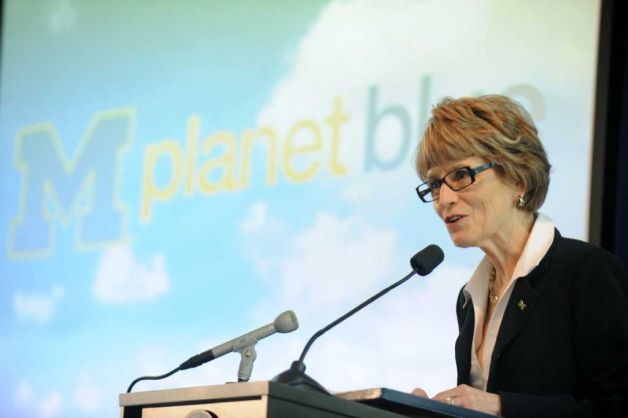
UM President Mary Sue Coleman declares University Commitment to Sustainability

"We will be aggressive and relentless.
As a campus, a community, and a planet,
there is no other approach to take.

I want the message to be clear:
Sustainability defines the
University of Michigan."

- Mary Sue Coleman,
University of Michigan President

Source: http://sustainability.umich.edu/news/going-green-staying-blue-sustainability-michigan

A few observations about her speech:

1) Coleman seems to view sustainability as something specific to environmental programs only. This view ought to be updated--clearly social justice and economic issues are integral to our relationship with the world we live on. Reading "The Death of Environmentalism" might be a good way to start out: http://thebreakthrough.org/PDF/Death_of_Environmentalism.pdf

Comprehensive sustainability in Institutions of Higher Education like the University of Michigan can provide a coherent focus for educational programs to address real world problems on the local and global level, while encouraging people to understand the interconnections between the scales. Advancing sustainability with exclusive focus on environment denies the opportunity for better insight to complex issues--how does one implement solutions justly to all communities concerned (social)? What is the most prudent course of action (economics) for doing so?

2) For those wondering, her hesitation to sign the President's Climate Change Commitment in the past seems to arise solely from legal concerns:

"After seeking expert counsel, we have concluded we cannot set a date by which we will achieve carbon neutrality. There is simply no viable way forward at this time to achieve such a feat, and I will not place an undue burden on the backs of future presidents of this great institution."

It's interesting to see that some of the legal pushback regarding accelerated anthropocentric climate change was carefully considered here. Perhaps I'll have more substantial comment about this later, but I wonder what recent climate change litigation (perhaps the communities bringing suit to major petrol industries?) prompted this statement.

3) A friend said: "Wow! So what does that mean for Dearborn? She talked a lot about Ann Arbor." Maybe she forgot about Dearborn and Flint; more likely, however, I suspect she doesn't have a good feel for what's going on in the way of sustainability at these other campuses.

Either that or she relied almost exclusively on the results from the report for the Ann Arbor campus "integrated assessment" for her speech.

In any case, this is a good opportunity for all of our campuses to take the lead and demonstrate what comprehensive sustainability at a University ought to be about. It would be nice if the three major campuses got together for a meeting of the minds between interested students, faculty, and staff finally.

Juliana Goodlaw-Morris of the National Wildlife Federation offered her support to help coordinate or moderate between the three campuses so we can flesh out a comprehensive framework for sustainability as The University of Michigan, but also so as to inform our particular needs at our specific geographical locations (Ann Arbor, Dearborn, Flint).

We've invited several key individuals from U of M Ann Arbor and U of M Flint to join us at Campus Sustainability Festival and hope that they'll join us there. We'll be as politely relentless and aggressive about getting something coherent going (as aggressive and relentless as civil students can be at least). We just need some reciprocal lovin' to come from them in the form of a "yes, let's do something together".

As an aside, I've got mixed feelings about that "aggressive and relentless" statement from President Coleman--it sounds more like an angry battle cry than anything else. In any case, it certainly was fun to use in this post!


Edit [Nov. 5 2011]:  I just found a separate article outlining additional goals for "The University", which brings forth additional questions and suggestions:

How do they define "The University"?

  • Protect the Huron River through best-in-class storm water control strategies and by applying 40 percent fewer chemicals to campus landscapes, and ensure that at least 30 percent of stormwater runoff does not flow into the Huron River.
Why wasn't the Rouge River watershed considered for better storm water control strategies?  The native garden/bioswale project is an excellent fit for meeting or surpassing the goal of a 40% reduction in chemical applications and 30% stormwater runoff reduction.

  • Promote sustainable foods while supporting more Michigan farmers and producers. From the residence halls to the unions and hospitals, the university is introducing new purchasing guidelines and making a commitment that at least 20 percent of U-M food comes from local and sustainable sources.
How does this affect our campus?  Do these policies apply to all UM campuses?  Where can we access these purchasing guidelines?  When does this take effect, and how does our contract with Aramark get adjusted?

Monday, September 12, 2011

September SEA Events

September is going to be a busy month for the SEA! See the "Resources" page on SEA's blog for a map of the campus. Come when you can, go when you must.

Tues. 13th 12:00-3:00pm: Student Organization Fair

Thurs. 15th 4:30-6:30pm:
SEA Meeting/potluck meet and greet

Fri. 16th 11:30am-1:00pm:
Sustainability Fest planning meeting and pot luck with EverGreenTeam

Sun. Sept. 18th 9:00am to 2:00pm:
SEA Working Day

Thurs. Sept. 22nd:
10:00 am:
City of Dearborn’s Adopt-A-Watt program launch at (RSVP required by Sep. 19)
4:30-6:00PM: SEA Meeting and Officer Elections

Welcome to the new semester! The autumn winds bring a rush of events for The Student Environmental Association here at UM-Dearborn, and you're invited to join us!

Tues. 13th 12:00-3:00pm Student Organization Fair--Can you help us greet incoming students and spread the word about SEA at our table behind the University Center? Please let us know, 15 minutes of your time can make a big difference in recruiting and finding out what's happening on campus!

Thurs. Sept. 15th 4:30-6:00pm Our semester kick-off meeting takes place -- let's make this one a meet-and-greet potluck for sustainability. We'll pick up on the summer's events and talk about the new semester, too.


Fri. 16th 11:30am-1:00pm: Sustainability Fest planning meeting with EverGreenTeam room 1070 Administrative Building (at UM-Dearborn's campus)


Theme for this year: Fresh Water. Join us as we plan and coordinate the events with various campus and community allies for this year's week long October festival on sustainability! (We'll make a better image for this year's festival theme)...

Sun. Sept. 18th 9:00AM to 2:00pm* SEA working day at the Environmental Interpretive Center! Help us out with various projects, make/distribute fliers, learn about native/invasive species, meet and greet friends new and old! We're hoping to finish up around 2:00 or 3:00 pm, but this depends on who will be available, what gets finished, and whether we decide to eat on campus or off.

Thurs. Sept. 22nd: TWO MONUMENTAL EVENTS IN ONE DAY!!
(two exclamation points to denote two significant things!!)

City of Dearborn Adopt-A-Watt program launch at 10:00 am on the West Parking Structure on West Village Drive in Dearborn’s west downtown

Launch of the City of Dearborn’s Adopt-A-Watt program at 10 a.m. on Thursday, Sept. 22, 2011. This public ribbon-cutting ceremony will recognize Adopt-A-Watt charter sponsors for their efforts to save energy and reduce City expenses through their adoption of new energy-efficient lights in one of our parking structures. The SEA helped the Dearborn Sustainability Coalition promote this program this summer at the Dearborn CARES Festival. Attached is a press release issued earlier this month by the Adopt-A-Watt organization.

Media will be invited, as will suppliers of energy efficient products and the Adopt-A-Watt founder, Thomas A. Wither.

Additional details about the program and organization are available at: http://adopt-a-watt.com/

Kindly confirm your attendance before September 19 by email (bcampbell@ci.dearborn.mi.us) or by calling the City of Dearborn Department of Public Information at 313-943-2285. Parking is free. Please show your invitation at the entrance.

SEA Meeting and Officer Elections at 4:30-6:00PM
The SEA has a meeting once again, elections for officership take place at this time, but you can also vote online (more on that this Thursday). We're looking for individuals interested in any of the officer positions. If you are interested in running for a position please let us know either via facebook or by e-mailing us confidentially at greenwolverines (at) ymail (dot) com .

We have many exciting projects and opportunities in the works for this term and we need some people to step up to the plate for leadership opportunities. If you have any questions please reach us!

Saturday Sept. 24th We will be selling our native plant seeds at the Master Gardeners Association of Wayne County conference here at UM-Dearborn and meeting many of the regions greatest greenthumbs.

As always, we welcome your interest and inquiries--feel free to reach us via facebook or e-mail!

Cheers to a fine new semester!

The Student Environmental Association at The University of Michigan-Dearborn

Tuesday, August 23, 2011

Plants to know and a cup of joe...our second science cafe!

Cardinal flower (Lobelia cardinalis)
is a native Michigan plant.

Its roots can grow to 8 feet!
Image compilation by Ian Tran,
coffee cup credit to Flickr user BallistikCoffeeBoy
Join us for a cup of bird-friendly coffee and discussion about the role of native plants in our communities!  


Ethical and legal concerns about landscaping? 


Find out from an individual who navigated them and made it happen in Dearborn Heights!

Curious about what plants can make a great habitat for many to enjoy? 


Let's further the dialog!


Thursday, August 25th 
6:00 pm
in room 116
UM-Dearborn Environmental Interpretive Center 
4901 Evergreen Road Dearborn, MI 48128

You're invited to join us for this informal discussion on native plants, landscaping, and our connection to it all to make a more vibrant ecosystemic and human community in the Southeast Michigan area via the landscapes we live with.

This science cafe features special guests, among them Steve Ray of the Dearborn Heights Watershed Commission, 
Martha Gruelle of the Stewardship Network, and of course: YOU!  Dearborn's Sustainability Coordinator and esteemed alum of UM-Dearborn David Norwood will also be joining us.

Also, we're hoping to serve Bird Friendly Coffee again, and will have fresh UM-Dearborn made honey.

Please RSVP to the Student Environmental Association at The University of Michigan-Dearborn here on our facebook event or at greenwolverines (at) ymail (dot) com so we can better plan the event.

Friday, July 22, 2011

Detroit Frack Ban Resolution status: unanimously passed!

The resolution didn't get on Tuesday's agenda, but it has been well represented and
voted on today (Friday the 22nd) during the noon session.

I called Chris Corrigan of the Detroit Food and Water Watch office at about 1:30 today and learned that the Detroit City Council passed the ban by unanimous vote.  This is literally a watershed event.  Most of the communities upstream in the Rouge River watershed (Westward from Dearborn out to Superior/Salem Townships, and North out to Rochester Hills, Bloomfield/West Bloomfield Townships, and Novi) get their municipal tap (drinking) water from the Detroit river--which the Rouge drains into.

As far as I could reckon, Food and Water Watch, Dearborn/Dearborn Heights League of Women Voters, the SEA, and Akinpelu twins were in attendance on Tuesday.  Details forthcoming as we find out what happens next. Those who spoke got their concerns for safety and its regional relevance to Southeast Michigan across--it piqued councilman Brown's interest and he expressed his thanks to all of the youth who came to represent their solidarity in the issue.  

Congratulations for your leadership Detroit, it's a major step forward in citizen and environmental protections.  Also, please be vigilant in following through--you can propose similar resolutions in your hometown too!

That said, I believe the city of Detroit and groups like Food and Water watch will also need to look in earnest toward something creative and solutions oriented for responsibly meeting energy and employment needs.  They've got very bright talents in the area, and it's time to make it known that Detroit's leadership is happening from all directions at all levels of Southeast Michigan.

Wednesday, April 13, 2011

What the Frack!?! Fracking Party: Gasland Screening Wed. April 20th 6:00pm-9:00

What  the  [is] frack!?!

Wed. April 20th 6:00pm-9:00 the SEA will be screening Gasland in the Environmental Interpretive Center at the University of Michigan-Dearborn:


Gasland is a documentary concerning Hydraulic fracturing (fracking)--a means of natural gas extraction within deep natural gas well drilling.  Once a well is drilled, millions of gallons of potable (drinking) water, along with sand and proprietary chemicals are injected under high pressure into a well. The pressure fractures shale rock and props open fissures that enable natural gas to flow more freely out of the well.


Awareness of this process and issue is especially relevant to us because Michigan and the Great Lakes basin are prime locations for natural gas extraction, and several communities have reported affliction  (see USGS/EIA maps below for existing natural gas locations).

 Furthermore, it's ongoing at present within our state. 


Gasland has been subject to several criticisms.  See some from:

1.  Energy In Depth--a blog assembled by a collection of U.S. Natural Gas and Oil producers 
2.  Blogger Kirian Stacey of the Financial Times
3.  Ongoing discussion by insightful folks at the Oil Drum (see comments near the end for people who actually worked in the industry and/or watched the film)--some of whom claim that the criticisms from Energy In Depth can be rebuked

We'll try to make sense of them and weigh out its merits with some geology, environmental science, sensibility, and civility.


Join us to examine the topic at hand, as well as the documentary itself--how are the issues communicated?  What does it mean to all of us as citizens and consumers of media and energy?  Also important to consider: what alternatives can we pursue to minimize our dependence on fossil fuel extraction and consumption altogether?


Trailer:


Please join us at this fracking party, popcorn and beverages will be served at the event, so it's a fine opportunity to stop by and take a break from your studies!!  Please RSVP to greenwolverines (at) ymail (dot) com