Showing posts with label Climate Change. Show all posts

Tuesday, May 21, 2013

Keystone going to vote in the House


Keystone XL likely up for vote tomorrow [1]. The health, social justice, and environmental side of the issue (though likely among the most important topics) probably won't get as far without a coherent alternative on the economic "job creation" side for those of the GOP [2]. Perhaps speaking about the risks to local economies can make a measured difference?

Recall that the communities in Kalamazoo/Marshall [3-5] and in the Gulf are still struggling (and some angry) to recover from spills in 2010 [6, 7].

What will we do?


[1] http://thinkprogress.org/climate/2013/05/21/2007191/may-21-news-gop-plans-keystone-approval-vote-tomorrow-house-dems-clarify-true-impact/

[2] An extrapolation based on Frank Luntz's insight.  Luntz remains a leading adviser for "messaging" strategy, in Washington, esp. to the GOP.  Phrases like "climate change" (promoted to reduce sense of alarm created by "global warming"), and "death tax" are a product of his advisory.
http://www.motherjones.com/mojo/2010/01/gop-pollster-luntz-tells-enviros-stop-talking-climate

[3]
http://environmentreport.org/enbridge_oil_spill.php

[4] Enbridge resisting final clean-up of spill as of January 2013 http://insideclimatenews.org/news/20130128/dilbit-6B-pipeline-kalamazoo-river-enbridge-oil-spill-michigan-keystone-xl-epa

[5]   ~Kalamazoo is nation's most costly oil spill
http://www.bloomberg.com/slideshow/2012-07-25/enbridge-s-quiet-765-million-oil-spill.html

[6] Check out the current news in Florida!
http://www.naplesnews.com/news/gulf-coast-oil-spill/

[7]  http://www.theatlantic.com/national/archive/2013/04/three-years-after-the-bp-spill-tar-balls-and-oil-sheen-blight-gulf-coast/275139/

Friday, September 30, 2011

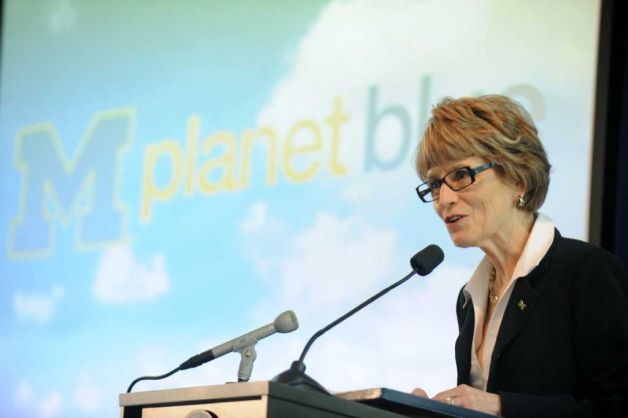
UM President Mary Sue Coleman declares University Commitment to Sustainability

"We will be aggressive and relentless.
As a campus, a community, and a planet,
there is no other approach to take.

I want the message to be clear:
Sustainability defines the
University of Michigan."

- Mary Sue Coleman,
University of Michigan President

Source: http://sustainability.umich.edu/news/going-green-staying-blue-sustainability-michigan

A few observations about her speech:

1) Coleman seems to view sustainability as something specific to environmental programs only. This view ought to be updated--clearly social justice and economic issues are integral to our relationship with the world we live on. Reading "The Death of Environmentalism" might be a good way to start out: http://thebreakthrough.org/PDF/Death_of_Environmentalism.pdf

Comprehensive sustainability in Institutions of Higher Education like the University of Michigan can provide a coherent focus for educational programs to address real world problems on the local and global level, while encouraging people to understand the interconnections between the scales. Advancing sustainability with exclusive focus on environment denies the opportunity for better insight to complex issues--how does one implement solutions justly to all communities concerned (social)? What is the most prudent course of action (economics) for doing so?

2) For those wondering, her hesitation to sign the President's Climate Change Commitment in the past seems to arise solely from legal concerns:

"After seeking expert counsel, we have concluded we cannot set a date by which we will achieve carbon neutrality. There is simply no viable way forward at this time to achieve such a feat, and I will not place an undue burden on the backs of future presidents of this great institution."

It's interesting to see that some of the legal pushback regarding accelerated anthropocentric climate change was carefully considered here. Perhaps I'll have more substantial comment about this later, but I wonder what recent climate change litigation (perhaps the communities bringing suit to major petrol industries?) prompted this statement.

3) A friend said: "Wow! So what does that mean for Dearborn? She talked a lot about Ann Arbor." Maybe she forgot about Dearborn and Flint; more likely, however, I suspect she doesn't have a good feel for what's going on in the way of sustainability at these other campuses.

Either that or she relied almost exclusively on the results from the report for the Ann Arbor campus "integrated assessment" for her speech.

In any case, this is a good opportunity for all of our campuses to take the lead and demonstrate what comprehensive sustainability at a University ought to be about. It would be nice if the three major campuses got together for a meeting of the minds between interested students, faculty, and staff finally.

Juliana Goodlaw-Morris of the National Wildlife Federation offered her support to help coordinate or moderate between the three campuses so we can flesh out a comprehensive framework for sustainability as The University of Michigan, but also so as to inform our particular needs at our specific geographical locations (Ann Arbor, Dearborn, Flint).

We've invited several key individuals from U of M Ann Arbor and U of M Flint to join us at Campus Sustainability Festival and hope that they'll join us there. We'll be as politely relentless and aggressive about getting something coherent going (as aggressive and relentless as civil students can be at least). We just need some reciprocal lovin' to come from them in the form of a "yes, let's do something together".

As an aside, I've got mixed feelings about that "aggressive and relentless" statement from President Coleman--it sounds more like an angry battle cry than anything else. In any case, it certainly was fun to use in this post!


Edit [Nov. 5 2011]:  I just found a separate article outlining additional goals for "The University", which brings forth additional questions and suggestions:

How do they define "The University"?

  • Protect the Huron River through best-in-class storm water control strategies and by applying 40 percent fewer chemicals to campus landscapes, and ensure that at least 30 percent of stormwater runoff does not flow into the Huron River.
Why wasn't the Rouge River watershed considered for better storm water control strategies?  The native garden/bioswale project is an excellent fit for meeting or surpassing the goal of a 40% reduction in chemical applications and 30% stormwater runoff reduction.

  • Promote sustainable foods while supporting more Michigan farmers and producers. From the residence halls to the unions and hospitals, the university is introducing new purchasing guidelines and making a commitment that at least 20 percent of U-M food comes from local and sustainable sources.
How does this affect our campus?  Do these policies apply to all UM campuses?  Where can we access these purchasing guidelines?  When does this take effect, and how does our contract with Aramark get adjusted?

Friday, April 8, 2011

Science Café #1: The Coffee Connection to Birds and Biodiversity

Photos and notes from our first Science Café: "The Coffee Connection to Birds and Biodiversity":


Thanks to everyone who came out -- special thanks to everyone who helped set up/tear down, featured guest speaker Sara Yearout for sharing her senior research project and passion for sustainably sourced foods, Julie Craves (head of Avian Research at Rouge River Bird Observatory and shade-grown coffee authority) for sharing her expertise, Sara Cole for sharing the photos, Birds and Beans for their wonderful "Chestnut-Sided Warbler" blend of coffee, and the SEA members who helped make this event happen! Though the books didn't arrive in time for the event, great things happened nonetheless.


In case you missed it, here are some "tasty tidbits" from the discussion:

  • "triple crown" (fair trade, organic, bird-friendly) coffee is the golden standard at this time.
  • Look out for the fine print on certified coffee! Some certifications, like those awarded by the Rainforest Alliance, may actually certify only a certain percentage of the coffee to be shade-grown (30% for example) in the fine print.
  • Some growers and suppliers cannot afford to get certified, but may still label their coffees as "bird-friendly".
  • Caribou Coffee is working to get all of their coffee Rainforest Alliance Certified by 2012, while Starbucks has internal standards for suppliers that tend more toward fair treatment of the farmers, but may not necessarily be bird-friendly at this time
  • For some insight on how coffee (and chocolate) tie in with climate change, this rainforest alliance webpage is a fair source: http://my.rainforest-alliance.org/site/MessageViewer?em_id=6361.0&dlv_id=10981
  • Even if you're not a coffee drinker, are there places where you can educate coffee consumers about their connection to coffee, or help them make more sustainable purchases? Local cafes, the workplace or at home might be good places to start.
  • Since coffee is exported into Michigan, it's worth recognizing that it does have a substantial ecological footprint.
Birds and Beans: http://www.birdsandbeans.com/
Sara's Co-Op, Ypsilanti Food Coop: http://www.ypsifoodcoop.org/
Equal Exchange Coop (Chocolates and other things): http://www.equalexchange.coop/

A pleasant coincidence I forgot to mention: the event was hosted at the Environmental Interpretive Center, a building was designed to look like a bird in flight from above!

Here's to drinking sustainably -- cheers!

Thursday, March 31, 2011

The Coffee Connection to Birds and Biodiversity (A Science Cafe!)

Wed. Apr. 6th 5:30-7:00 room 119 of the Environmental Interpretive Center
The Coffee Connection to Birds and Biodiversity science cafe

Even if you're not a coffee drinker, find out how you can:
-Preserve rain forests, birds, and other fauna
-Make a difference in climate change
-Create new economic opportunities for coffee plantation owners and farmers
-Help others drink better quality coffee
Plus, free samples of bird-friendly coffee and a raffle for a hardcover autographed copy of Bridget Stutchbury’s ‘Silence of the Songbirds’ all courtesy of Birds and Beans (Thanks!).
Join us for this informal discussion featuring UM-Dearborn Environmental Studies senior, Sara Yearout!

Please rsvp to greenwolverines (at) ymail (dot) com or on our facebook event page so we can better plan the event.

Thursday, November 11, 2010

Footage and Photos from 10/10

The Cool Cities Dearborn Sierra Club brought together several groups to host events on 10/10 as initiated under 350.org.

Dearborn's Community Television Channel also got footage of some of our activities and interviewed us:

I'm finally uploading pictures from 10/10!  It was a great event with upwards of ~45 people joining us to enjoy the outdoors for the Global Work Party Climate Action Day to walk, learn about the area, put bottled water to the test against tap (LWVDDH report no significant difference in preferences, but tap is 1,000 times cheaper!), paint pumpkins and gourds, and meet other community members.

Jenni Dunn of the Dearborn/Dearborn heights League of Women Voters at the blind tap vs. bottled water taste test table. Find out more about their actions and findings at their blog post on the 10/10 tap water taste test! 
Attendees gather for opening remarks on environmentally conscientious recreation, sustainability, and climate action from Ian Tran and Shannon Morrow before touring the Environmental Interpretive Center rain gardens, natural areas, and Rouge River Henry Ford Estate.
Pumpkin!  Apple from Apple Charlie's!  Cider and donuts also came from Apple Charlies, and we had attendees use compostable cups as planters for wild mountain mint (Pycnathemum pilosum) seeds collected by SEA--it was a leave-no trace event so all other items were composted or taken back for recycling/reuse.  The Fordson High School Environmental Club came forth in strong numbers and hosted the pumpkin painting table.

350.org participants gathered in all kinds of shapes, we made an Evergreen 1Sky, and the Sierra Club have signs up.
Several local parents hiked with their children, literally!


Saturday, October 9, 2010

Global+Local=GLOCAL! 10/10 Global Work Party happening in Dearborn!

The Dearborn Sierra Club Cool Cities Group, Dearborn/Dearborn Heights League of Women Voters, Student Environmental Association (SEA), and Fordson High School Environmental Club are getting ready for 350.org's  international "Global Work Party" day this Sunday 10/10 2:00-4:00 at the University of Michigan-Dearborn Environmental Interpretive Center (4901 Evergreen Road, Dearborn MI 48128) and you're invited to join us for the event!


You can join us for a low-carbon walk through the Henry Ford Estate Grounds/Natural Area to the community organic gardens, cider and donuts from Apple Charlie's, a discussion on environmentalism, trade tips with other cool citizens on energy conservation, sustainable food options, gourd painting (perfect for Halloween preparations!), you even can plant some wild mountain mint collected by the SEA to take home.

What's even more exciting is that over 7,000 events like this are going to happen world wide on the same day (but none are quite the same as our adventure in the making!).  Perhaps "glocal" would be a good way to describe this kind of event.  It's a coordinated local activity with global impacts--a conjugation of the phrase "think global, act local"... Global+Local=Glocal.

All of these events revolve around themes of community building, climate change action, and enjoying what you're doing in the process.  You can find out more and RSVP at 350.org .  Of course, you can just stop by and join us too.

People of all ages are welcome, unfortunately pets are not because the walk goes through a research area at the University.

Tuesday, September 14, 2010

The Vegan Sub Sandwich Option

Do you like healthier, affordable, environmentally and ethically responsible food options?

If yes, then we're pleased to inform you that Dr. Skrbina's vegan sub sandwich proposal to the campus Subway as a viable way to make it happen sooner.  These arguments are applicable to campuses everywhere, but you may have to check the prices.  Our campus subway charges a bit more across the board than most other subways do.  Here's a bit from Dr. Skrbina:

At present there is only one way to buy a vegan sub: the Veggie Delight (all fresh vegetables), with vinegar and oil dressing. This sells for $5.29, the same price as if the customer included cheese, egg-product, and dairy
dressing. By comparison, the ham sub is $5.89—just $0.60 more. Subway’s (and Aramark’s) profit margin on such a ‘vegan sub’ is undoubtedly huge—surpassing every other product they sell, given that the ingredients are the lowest-cost. And given that a ‘$5 footlong’ is a viable product, and 3 for $12, we should expect a sub-$5
price on the vegan alternative.

In effect, buyers of a vegan sub are subsidizing the non-vegan and meat subs. Based on the above facts, it should be the other way around: vegan subs should be the cheapest, and the cost burden placed on the meat.
 Full paper below:

Sunday, July 25, 2010

On climate change: A handful of resources and reflections

I've been relatively quiet about climate change activism for the past two years because there are so many moving parts involved with the issue, and it took time for me to get my head around what was going on.  Most everyone involved has good intentions, there are many perspectives, and understanding many of the solutions--not to mention knowing which ones are being considered or included can be a daunting task.  Furthermore, there are many groups working toward a similar goal, but I couldn't understand why they didn't work together.  I've finally seen, heard, and learned enough to offer some organizations seeking to coordinate efforts that you can take action with, and handful of quality resources for you to investigate as a supplement to the previous letter.

There are four sections below:
  1. Courses+some comments on political efficacy
  2. Cap and Trade in climate legislation and how it could improve
  3. My take on Repower America
  4. Climate change as an issue of sustainability

These draw from my experiences as a student, an attendee at many a conference, and various other ventures in the arena of climate change.  Clearly, it's my perspective, but I hope it serves to be a useful starting guide to you if you're about to dive in.


Climate Change: Our democracy, everyone's planet, a call to action

Green wolverines, wolves, and friends of the SEA:

Harry Reid recently announced that the climate bill will not be addressed this year.  The ethical implications and research beckons us to promptly take prudent action on climate change.

Embracing the issue as civil individuals and acting as a society is among humanity's greatest of challenges.  Respected peers at the Sierra Club and Repower America are looking for volunteers, and you can help unite the voices of Michigan's communities to bring and keep a good bill back onto the national agenda until it has become law.

As informed citizens, we can charge our representatives to hold the national legislation accountable to its people and the well being of our global community--biotic and abiotic.

Furthermore, we can also demand that the legislation includes appropriate solutions to meet the challenges of climate change.  We are the people, this is our democracy.  We are all members of the UM community, we are the leaders and the best.

Sincerely,
Ian D. Tran
-
President, The Student Environmental Association at The University of Michigan-Dearborn
p.s.
I'd feel irresponsible if I urged you to action without providing some credible resources and thoughtful analysis, here's a link to a sustainability project called "The Story of Stuff" by a thoughtful and articulate activist named Annie Leonard.  She nicely communicates the cap and trade system and things we can do to strengthen the bill in a video, and the transcript has citations for her sources: http://storyofstuff.com/capandtrade/

You can view some of my thoughts and supplements here on the blog concerning some of the organizations listed above, metrics for political efficacy, and recommendations for useful classes offered at UM-Dearborn.
The Volunteer Schedule