Bioswale project: We hope that the bioswale project will illustrate how native plants can be used as traditional garden plantings at the bridge between the ScienceBuilding and the Mardigian Library. Using similar principles described in the Native Seeds Project, we hope to provide signage that encourages students to interact more intimately with the ecosystems found on accessible areas of the campus. We aim to establish and increase inter-organizational coalition strength, leadership, and demonstrate interdisciplinary place-based project learning.
Here are some experiments I came up with that others might be interested in trying (fair warning to UM-Dearborn, I'll offer this to you guys first, but don't be surprised if I put up research projects on Craigslist and open it up to the rest of Michigan academia):
Showing posts sorted by relevance for query bioswale. Sort by date Show all posts
Saturday, March 6, 2010
Wednesday, May 19, 2010
What's up at the University thusfar in sustainability...
There's a lot of stuff going on under the radar, so I thought I'd let you all know about some of it here as it pertains to the SEA and UM-Dearborn:
One agreed upon goal was to offer healthier food options, and to ensure ethical/responsible/sustainable food system practices. This has also on Student Government's platform of agenda items, but both the panel and vice versa didn't know that they were working on the same thing.
Two visible action items are growing out of this:
-a comprehensive sustainability policy (I think I'm the only one looking into it right now, feel free to prove me wrong)
-a proposal for a cheap vegan sub sandwich to offset environmental and health impacts (a brilliant brainchild of Dr. Skrbina's)
After unsuccessful attempts to reach and join the United Students or Fair Trade via SEA (I'm guessing spotty internet connection when I pressed submit--I'd try again, but it was a detailed form to fill out so maybe later), we have reached out to food justice groups like the Coalition of Imokalee Workers to see what's going on with our current food contracts and food service's operations. Aramark is at the table with the CIW and recently made an agreement to pay more for tomatoes as of January, so we can move on to watch for Kroger (the grocery store) some time on the horizon.
Through a very helpful person named Meghan from the Student Farworkers Alliance/CIW, I recently came across the Real Food Challenge's resources and was delighted to find a plethora of useful things: We can find out about all of UM-Dearborn's contracts via FOIA requests (here's a useful guide for food services) and add them to the contract database! Plus, there were examples for Sustainable University Policy (Huzzah!!!), which brings us to the next point...
To strengthen our actions in the food initiatives and other activities in the community, we're proposing that the University passes a sustainable charter that would be used to hold all future contractors to the University's standards of ethical operations within sensible time frames.
The great news is that we don't have to reinvent the wheel--The University of California and Brown University already passed comprehensive Sustainable University Policies and Student Government resolutions!
Eventually, things like sustainability and civic minded curriculum will be at the forefront of the agenda for the University, but one thing at a time...
The Sierra Club Dearborn Cool Cities group is looking to ask the mayor to formalize a sustainability panel for the city (in accordance with the city's proposal for comprehensive sustainable education and outreach) and at the same time, UM-Dearborn's EverGreen Team have been waiting to do the same with the university. The Detroit Regional Chapter U.S. Green Building Council Green Schools committee is also checking out Dearborn to offer educational consulting services... might I add that the word "coalition" is under discussion?
In other things, SEA's being promoted in several places: you can find us on the Engineering Society of Detroit's Affiliate Council (we're an affiliate society, which has really nice benefits like meeting lots of non-profit groups in the region, tasty discounts, and other stuff), at idealist.org under the affinity groups, at greeningdetroit.com next to MSU's sustainability group, and the blogs page of the Association for the Advancement of Sustainability in Higher Education (AASHE)
I've also found a few articles in The Reporter mentioning our events and activities (Thanks Jennifer Thelen!).
Henry Ford Estate (yes, the one on our campus) is also looking for help--and it's not too late! They plan to remove more Garlic Mustard this Friday, and are.
JUNE 5th: SEA and Volunteer Dearborn are hosting UM-Dearborn's Rouge Rescue Day (and all are invited to join!). Before then, we're figuring out how we could squeeze in some bioswale site surveying and are looking for some landscape architects who'd be willing to contribute some time in coaching us on how to make a viable remediation plan so that we can propose the bioswale to campus Facilities Planning and Management.
That's all for now I think...
- Campus food reform
One agreed upon goal was to offer healthier food options, and to ensure ethical/responsible/sustainable food system practices. This has also on Student Government's platform of agenda items, but both the panel and vice versa didn't know that they were working on the same thing.
Two visible action items are growing out of this:
-a comprehensive sustainability policy (I think I'm the only one looking into it right now, feel free to prove me wrong)
-a proposal for a cheap vegan sub sandwich to offset environmental and health impacts (a brilliant brainchild of Dr. Skrbina's)
After unsuccessful attempts to reach and join the United Students or Fair Trade via SEA (I'm guessing spotty internet connection when I pressed submit--I'd try again, but it was a detailed form to fill out so maybe later), we have reached out to food justice groups like the Coalition of Imokalee Workers to see what's going on with our current food contracts and food service's operations. Aramark is at the table with the CIW and recently made an agreement to pay more for tomatoes as of January, so we can move on to watch for Kroger (the grocery store) some time on the horizon.
Through a very helpful person named Meghan from the Student Farworkers Alliance/CIW, I recently came across the Real Food Challenge's resources and was delighted to find a plethora of useful things: We can find out about all of UM-Dearborn's contracts via FOIA requests (here's a useful guide for food services) and add them to the contract database! Plus, there were examples for Sustainable University Policy (Huzzah!!!), which brings us to the next point...
- University Sustainability Policy
To strengthen our actions in the food initiatives and other activities in the community, we're proposing that the University passes a sustainable charter that would be used to hold all future contractors to the University's standards of ethical operations within sensible time frames.
The great news is that we don't have to reinvent the wheel--The University of California and Brown University already passed comprehensive Sustainable University Policies and Student Government resolutions!
Eventually, things like sustainability and civic minded curriculum will be at the forefront of the agenda for the University, but one thing at a time...
- Community outreach and engagement
The Sierra Club Dearborn Cool Cities group is looking to ask the mayor to formalize a sustainability panel for the city (in accordance with the city's proposal for comprehensive sustainable education and outreach) and at the same time, UM-Dearborn's EverGreen Team have been waiting to do the same with the university. The Detroit Regional Chapter U.S. Green Building Council Green Schools committee is also checking out Dearborn to offer educational consulting services... might I add that the word "coalition" is under discussion?
In other things, SEA's being promoted in several places: you can find us on the Engineering Society of Detroit's Affiliate Council (we're an affiliate society, which has really nice benefits like meeting lots of non-profit groups in the region, tasty discounts, and other stuff), at idealist.org under the affinity groups, at greeningdetroit.com next to MSU's sustainability group, and the blogs page of the Association for the Advancement of Sustainability in Higher Education (AASHE)
I've also found a few articles in The Reporter mentioning our events and activities (Thanks Jennifer Thelen!).
- Habitat restoration/preservation (invasive species removal right now, native plantings June 5th--assuming we have a landscape plan in place)
Henry Ford Estate (yes, the one on our campus) is also looking for help--and it's not too late! They plan to remove more Garlic Mustard this Friday, and are.
JUNE 5th: SEA and Volunteer Dearborn are hosting UM-Dearborn's Rouge Rescue Day (and all are invited to join!). Before then, we're figuring out how we could squeeze in some bioswale site surveying and are looking for some landscape architects who'd be willing to contribute some time in coaching us on how to make a viable remediation plan so that we can propose the bioswale to campus Facilities Planning and Management.
That's all for now I think...
Tuesday, April 6, 2010
Bioswale project: Department of brainstorm
I spoke with our friends at the Friends of the Rouge the other day to invite them to visit the SEA to re-introduce themselves and share some sage advice with us about putting in bioswales and reclaiming Phragmites-covered(conquered? FYI, Fragmites are tall, densely growing invasive plants that look like major league flowering grasses on steroids) vernal ponds with landscaped native plants.
Please let us know if there's anyone interested in helping SEA lead the educational, conservation, or coordination of the project.
Hopefully, the SEA and others can recruit volunteer landscape architects, graduate students, project managers, and anyone else who'd be interested in sharing their expertise by teaching us useful things to do for our campus starting with the 'swale.
Also, be sure to sign up for Rouge River Rescue day June 5th at your local site or maybe even UM-Dearborn (SEA will be working there on the swale at that time, as well as several other sites in conjunction with Volunteer Dearborn)!
Currently, a group of students (including myself) enrolled in Dr. Riebesell's Environmental Science lab plan to lay out a landscaping plan as part of our lab project. I'd like invite you to call us "Team Land Plan". Also, you're welcome to join us for that too!
Please let us know if there's anyone interested in helping SEA lead the educational, conservation, or coordination of the project.
Hopefully, the SEA and others can recruit volunteer landscape architects, graduate students, project managers, and anyone else who'd be interested in sharing their expertise by teaching us useful things to do for our campus starting with the 'swale.
Also, be sure to sign up for Rouge River Rescue day June 5th at your local site or maybe even UM-Dearborn (SEA will be working there on the swale at that time, as well as several other sites in conjunction with Volunteer Dearborn)!
Currently, a group of students (including myself) enrolled in Dr. Riebesell's Environmental Science lab plan to lay out a landscaping plan as part of our lab project. I'd like invite you to call us "Team Land Plan". Also, you're welcome to join us for that too!
Labels:
Bioswale,
Invasive Species,
Research,
Rouge River,
Service Learning
Sunday, November 6, 2011
SEA Fall Reflections
Hi there -- SEA here! We've been very busy bees here on campus the past few weeks. We we move from fall to winter, we thought it might be a good idea to reflect on some of the great things we have done, and some of the great things we have to look forward to. Here a few highlights so far from the Fall 2011 Semester.

Sunday-morning seed gathering - what a great day to be outside!
Annual Native Seed Harvest (October 3) - What could be more pleasant than meeting in the rain garden on a Sunday Morning? On that fateful day, we shook, thrashed and picked seeds from native flowering species in the EIC rain garden and collected them in bags. After that, we sorted, dried and packaged the seeds for the SEA's Native Plant Fundraiser.

Campus Ecology Discussion with National Wildlife Federation's Juliana Goodlaw-Morris (October 19) - How do you coordinate sustainability initiatives on college campuses? Julianna Goodlaw-Morris, Campus Field Coordinator for the National Wildlife Federation’s Campus Ecology Program, was able to shed some light on this topic at UMD just in time for our Sustainability Week. Miss Goodlaw-Morris works throughout the Midwest region assisting college campuses with campus sustainability programs, finding ways to reduce greenhouse gas emissions, and works with students and faculty to bring sustainability to the forefront of all campus activities.

Soaring Bird, by Sara Cole - A creative work made of materials in the UMD Natural Area
Sense of Wonder Open Art Exhibition (October 19) - This was a sustainability-themed art show co-sponsored by the Student Environmental Association and the Lyceum at the University of Michigan - Dearborn. The SEA was well-represented in the show with a good percentage of the works being submitted by current or past SEA members. Artwork displayed for the day on the University Center stage.

Professor William Seacrest, Professof from Henry Ford Community College, participating in group discussion
Earth, Ethics, and Religion Roundtable Discussion (October 20) - More than forty people showed up to this special event, making it one of our most successful events of the semester. The main goal of this roundtable discussion was to explore the intersections that exist between religion and environmentalism, and the commonalities/differences between different faiths and the ways they regard the Earth. Featured guests included William Seacrest from Henry Ford Community College, UMD Biology Professor Orin Gelderloos, and UMD Professor and Ecotheology Scholar David Skrbina. (Look forward to a "Suggested Reading List" made of titles gleaned from this event -- we should have it compiled by the end of the semester!)

The first SEA Bake Sale of the season was held in the Fairlane Center.
Fall Bake Sale (October 27) - We made over $90! Thank you to all who provided or purchased some of our delicious baked goods. See more photos here. (If you missed our first bake sale, don't worry -- we have another bake sale coming up soon!)
Currently in the works:
Did you notice that our blog also has a new look? Let us know what you think.
Cheers to a warm, plentiful, and productive November!

Sunday-morning seed gathering - what a great day to be outside!
Annual Native Seed Harvest (October 3) - What could be more pleasant than meeting in the rain garden on a Sunday Morning? On that fateful day, we shook, thrashed and picked seeds from native flowering species in the EIC rain garden and collected them in bags. After that, we sorted, dried and packaged the seeds for the SEA's Native Plant Fundraiser.

Campus Ecology Discussion with National Wildlife Federation's Juliana Goodlaw-Morris (October 19) - How do you coordinate sustainability initiatives on college campuses? Julianna Goodlaw-Morris, Campus Field Coordinator for the National Wildlife Federation’s Campus Ecology Program, was able to shed some light on this topic at UMD just in time for our Sustainability Week. Miss Goodlaw-Morris works throughout the Midwest region assisting college campuses with campus sustainability programs, finding ways to reduce greenhouse gas emissions, and works with students and faculty to bring sustainability to the forefront of all campus activities.

Soaring Bird, by Sara Cole - A creative work made of materials in the UMD Natural Area
Sense of Wonder Open Art Exhibition (October 19) - This was a sustainability-themed art show co-sponsored by the Student Environmental Association and the Lyceum at the University of Michigan - Dearborn. The SEA was well-represented in the show with a good percentage of the works being submitted by current or past SEA members. Artwork displayed for the day on the University Center stage.

Professor William Seacrest, Professof from Henry Ford Community College, participating in group discussion
Earth, Ethics, and Religion Roundtable Discussion (October 20) - More than forty people showed up to this special event, making it one of our most successful events of the semester. The main goal of this roundtable discussion was to explore the intersections that exist between religion and environmentalism, and the commonalities/differences between different faiths and the ways they regard the Earth. Featured guests included William Seacrest from Henry Ford Community College, UMD Biology Professor Orin Gelderloos, and UMD Professor and Ecotheology Scholar David Skrbina. (Look forward to a "Suggested Reading List" made of titles gleaned from this event -- we should have it compiled by the end of the semester!)

The first SEA Bake Sale of the season was held in the Fairlane Center.
Fall Bake Sale (October 27) - We made over $90! Thank you to all who provided or purchased some of our delicious baked goods. See more photos here. (If you missed our first bake sale, don't worry -- we have another bake sale coming up soon!)
Currently in the works:
- Keystone XL Pipeline Photo Petition
- Keystone XL Pipeline Research Document (created in partnership with the Student Environmental Group at Fordson High School and the Student Environmental Action Leaders at Wayne State University)
- SEA Bioswale Proposal
Did you notice that our blog also has a new look? Let us know what you think.
Cheers to a warm, plentiful, and productive November!
Friday, September 30, 2011
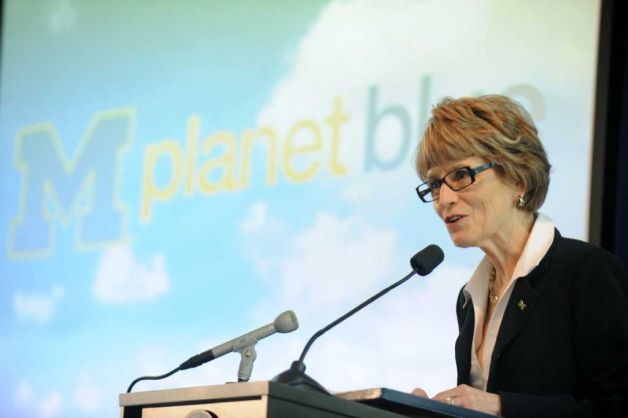
UM President Mary Sue Coleman declares University Commitment to Sustainability
"We will be aggressive and relentless.As a campus, a community, and a planet,
there is no other approach to take.
I want the message to be clear:
Sustainability defines the
University of Michigan."
- Mary Sue Coleman,
University of Michigan President
Source: http://sustainability.umich.edu/news/going-green-staying-blue-sustainability-michigan
A few observations about her speech:
1) Coleman seems to view sustainability as something specific to environmental programs only. This view ought to be updated--clearly social justice and economic issues are integral to our relationship with the world we live on. Reading "The Death of Environmentalism" might be a good way to start out: http://thebreakthrough.org/PDF/Death_of_Environmentalism.pdf
Comprehensive sustainability in Institutions of Higher Education like the University of Michigan can provide a coherent focus for educational programs to address real world problems on the local and global level, while encouraging people to understand the interconnections between the scales. Advancing sustainability with exclusive focus on environment denies the opportunity for better insight to complex issues--how does one implement solutions justly to all communities concerned (social)? What is the most prudent course of action (economics) for doing so?
2) For those wondering, her hesitation to sign the President's Climate Change Commitment in the past seems to arise solely from legal concerns:
"After seeking expert counsel, we have concluded we cannot set a date by which we will achieve carbon neutrality. There is simply no viable way forward at this time to achieve such a feat, and I will not place an undue burden on the backs of future presidents of this great institution."
It's interesting to see that some of the legal pushback regarding accelerated anthropocentric climate change was carefully considered here. Perhaps I'll have more substantial comment about this later, but I wonder what recent climate change litigation (perhaps the communities bringing suit to major petrol industries?) prompted this statement.
3) A friend said: "Wow! So what does that mean for Dearborn? She talked a lot about Ann Arbor." Maybe she forgot about Dearborn and Flint; more likely, however, I suspect she doesn't have a good feel for what's going on in the way of sustainability at these other campuses.
Either that or she relied almost exclusively on the results from the report for the Ann Arbor campus "integrated assessment" for her speech.
In any case, this is a good opportunity for all of our campuses to take the lead and demonstrate what comprehensive sustainability at a University ought to be about. It would be nice if the three major campuses got together for a meeting of the minds between interested students, faculty, and staff finally.
Juliana Goodlaw-Morris of the National Wildlife Federation offered her support to help coordinate or moderate between the three campuses so we can flesh out a comprehensive framework for sustainability as The University of Michigan, but also so as to inform our particular needs at our specific geographical locations (Ann Arbor, Dearborn, Flint).
We've invited several key individuals from U of M Ann Arbor and U of M Flint to join us at Campus Sustainability Festival and hope that they'll join us there. We'll be as politely relentless and aggressive about getting something coherent going (as aggressive and relentless as civil students can be at least). We just need some reciprocal lovin' to come from them in the form of a "yes, let's do something together".
As an aside, I've got mixed feelings about that "aggressive and relentless" statement from President Coleman--it sounds more like an angry battle cry than anything else. In any case, it certainly was fun to use in this post!
Edit [Nov. 5 2011]: I just found a separate article outlining additional goals for "The University", which brings forth additional questions and suggestions:
How do they define "The University"?
- Protect the Huron River through best-in-class storm water control strategies and by applying 40 percent fewer chemicals to campus landscapes, and ensure that at least 30 percent of stormwater runoff does not flow into the Huron River.
Why wasn't the Rouge River watershed considered for better storm water control strategies? The native garden/bioswale project is an excellent fit for meeting or surpassing the goal of a 40% reduction in chemical applications and 30% stormwater runoff reduction.
- Promote sustainable foods while supporting more Michigan farmers and producers. From the residence halls to the unions and hospitals, the university is introducing new purchasing guidelines and making a commitment that at least 20 percent of U-M food comes from local and sustainable sources.
How does this affect our campus? Do these policies apply to all UM campuses? Where can we access these purchasing guidelines? When does this take effect, and how does our contract with Aramark get adjusted?
Subscribe to:
Posts (Atom)